
In conversation with Bhavini Shah, Head of Diversity, Equity & Inclusion, Montagu Evans
By Priya Aggarwal-Shah, March 2026
Montagu Evans has been a long-standing corporate partner of PREACH Inclusion, with a clear commitment to building a more inclusive and equitable workplace. In this interview, Priya Aggarwal-Shah sat down with Bhavini Shah, the firm’s Head of Diversity, Equity & Inclusion (DE&I), to discuss her journey into the sector, her career as a surveyor, and the work required to embed cultural change across a business.
Education and route into surveying

Bhavini Shah, Montagu Evans
Bhavini grew up in a traditional Indian household in multicultural London, where education was strongly emphasised. Her parents had not had the same opportunities, and this shaped the value placed on learning and progression. She studied History and Politics at the University of Leicester, choosing the subjects simply because she enjoyed them.
After graduating, she worked in an office for a couple of years before going backpacking with her sister. It was during that early office job that she first heard colleagues talking about surveying. Curious, she began researching the profession and applied to study at Reading University before travelling.
“I didn’t fully understand what I’d signed up for,” she recalls, “but something about it felt right.”
Bhavini began her career during the 2008/09 recession, a challenging time for any new graduate entering the sector. She secured a series of internships with developers, which gave her early exposure to the development process and confirmed that this was the area she wanted to specialise in.
“I grabbed every opportunity I could,” she says. “Those internships showed me how much I enjoyed development work.”
She later joined King Sturge (now JLL), where she qualified as a surveyor and continued to build her experience.
A career in practice
Before moving into DE&I, Bhavini built her career in surveying.
She joined Montagu Evans in 2014 as a Senior Surveyor, working across development, viability and public-sector projects. One of the most significant chapters of her surveying career was her work on NHS property, including the redevelopment of Chase Farm Hospital in north London.
The project brought together one of the most diverse teams she had ever worked with — nurses, doctors, clinical specialists, project managers, surveyors and a multitude of other property professionals all collaborating on a complex redevelopment.
“It was the first time I’d seen such a diverse range of expertise working together,” she says. “It showed me how many different perspectives it takes to make a place work.”
Seeing the completed hospital in use was a defining moment.
“Walking through the finished building and knowing the impact it would have on patients and staff was incredibly powerful,” she adds.
Transitioning into DE&I
After many years in surveying, Bhavini moved into Montagu Evans’ dedicated DE&I role. The shift from external, client-facing work to internal culture-building required a different type of engagement, but many of her skills transferred naturally.
Her long tenure at the firm, combined with her experience as Executive Sponsor for Open Circle — Montagu Evans’ race and ethnicity network — gave her a strong foundation. The business also invested in coaching and development to support her transition.
“You’re speaking to the same colleagues, but the conversations are completely different,” she says. “Having trust already in place made a huge difference.”
A strategy built on Three Pillars
In early 2026, Bhavini established a new DE&I strategy within Montagu Evans, reinforcing DE&I as a core part of our growth strategy, one that is structured around three pillars: Connect, Challenge and Embed.
“Leadership has put DE&I at the heart of the company strategy. It signals that this work is essential, not optional.”
Connect focuses on building understanding across the business and with external partners. This includes events, employee networks, client engagement and collaborations.
Challenge encourages both structural and individual reflection. The firm is committed to reviewing its systems and processes, while also encouraging colleagues to examine their own assumptions and biases.
Embed is about making inclusive behaviours part of everyday practice. Accountability sits at every level of the partnership.
“Leadership has put DE&I at the heart of the company strategy,” Bhavini notes. “It signals that this work is essential, not optional.”
She also emphasises the importance of bringing everyone into the conversation.
“When systems work better for everyone, the outcome is greater equity for all.”
Internal initiatives and cultural shifts
One of the most impactful DE&I initiatives at Montagu Evans has been the This Is ME series, where colleagues share lived experiences through panel discussions, newsletters, and social media posts. This campaign has explored neurodivergence, intergenerational experiences and parenting.
Following a panel about neurodiversity, a junior colleague who recently joined Montagu Evans approached Bhavini to say that seeing colleagues speak openly about their neurodivergence gave them the confidence to open up to their line manager.
“That’s the kind of change that matters,” she says.
Data has been another major focus. When Bhavini stepped into the role, DE&I data completion sat at around 50% and is now at approximately 80%.
“PREACH Inclusion’s corporate partner roundtables helped us understand how to build the narrative around why data matters,” she explains. “That’s been crucial.”
She has also seen a cultural shift in colleagues’ willingness to share their stories and challenge norms.
The value of external partnerships
Montagu Evans’ external partnerships play a central role in its DE&I work.
Events delivered with PREACH Inclusion — including a conversation with Hashi Mohamed, (planning barrister and author of People Like Us), and a South Asian Heritage Month panel featuring an artist, colleagues and guest speakers of all levels — have sparked honest dialogue and brought intergenerational voices and perspectives into the room.
“PREACH Inclusion’s corporate partner roundtables helped us understand how to build the narrative around why data matters. That’s been crucial.”
The firm also works with We Rise In — a specialist leadership development company for Black minority ethnic professionals — and runs a Reverse Mentoring programme. Senior leaders have shared how transformative these experiences have been.
“You can see their thinking shift in real time,” Bhavini says.
Partnerships with schools have also been particularly meaningful. Some students have never been in an office before, and these placements have started to convert into apprentices with the firm – a wonderful full-circle moment.
“As a City business, we have a responsibility to open doors,” she adds.
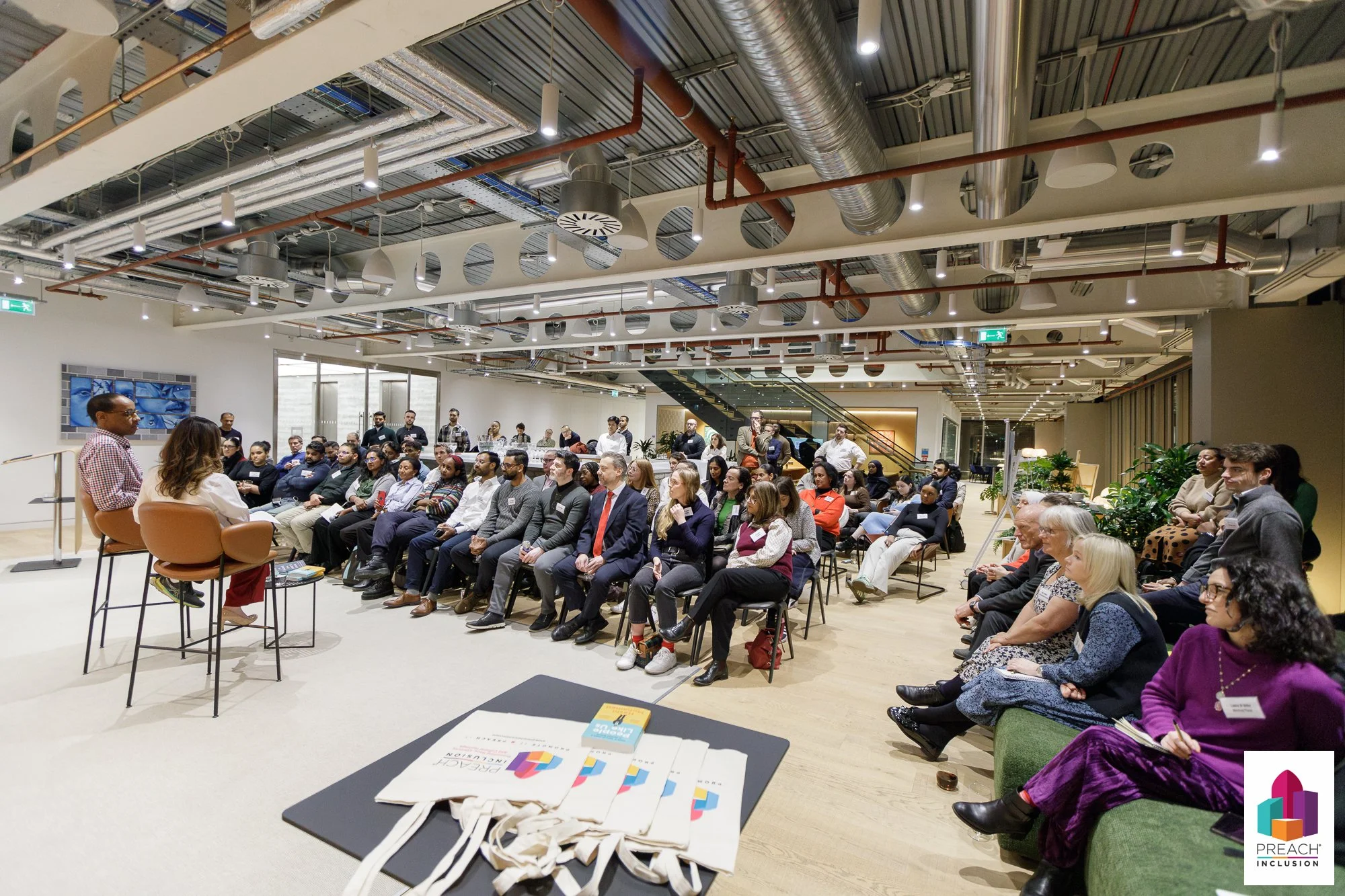

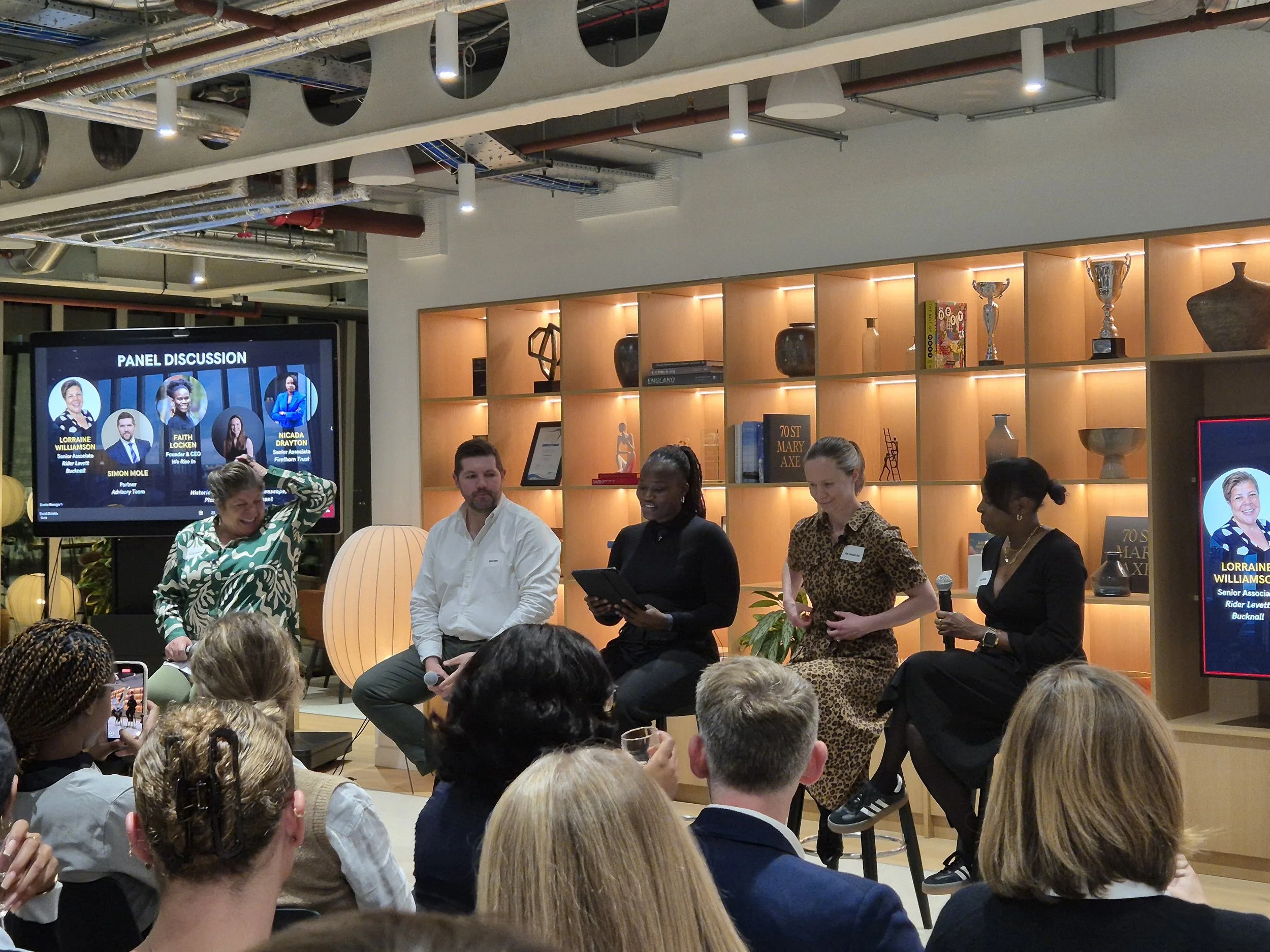
Photos: PREACH Inclusion’s event with Hashi Mohamed, sponsored by Montagu Evans (images 1-2). Montagu Evans’ Black History Month event with We Rise in (image 3).
Engaging senior leaders
Bhavini is clear that engaging senior leaders requires a tailored, pragmatic approach. For her, the starting point is always understanding the audience.
“You have to speak the same language,” she says. “Leaders want to know how DE&I supports the sustainability of the business — commercially, culturally and operationally.”
Data plays a central role in these conversations. She points to the firm’s work on extending paternity leave as an example of how evidence can drive policy change.
“When you can show the data, the conversation shifts. It becomes about what’s right for the business as well as what’s right for people.”
She also emphasises the importance of an “inclusion for all” approach — one that recognises the needs and experiences of every colleague, not only those from underrepresented groups. Storytelling is a key part of this, helping leaders connect emotionally as well as intellectually.
“You have to speak the same language,” she says. “Leaders want to know how DE&I supports the sustainability of the business — commercially, culturally and operationally.”
Relevance, in particular, matters. She often frames DE&I through the lens of client expectations, which has proven effective.
“Clients aren’t just talking about inclusion — they’re doing it. When leaders see that everyone is pushing in the same direction, it resonates.”
A major mindset shift she works to embed is moving DE&I away from being perceived as an additional task.
“It’s not something extra to do,” she says. “If we lead well, we do well as a business.”
Her time as a fee earner also shapes her approach. Having reached the role of Partner at Montagu Evans, she understands the pressures colleagues face and adapts accordingly — including scheduling events outside of peak delivery periods.
“Empathy goes a long way. When people feel understood, they’re more open to engaging.”
Finally, she stresses the importance of creating safe spaces where leaders can ask questions and learn without judgement.
“If the environment is safe, they stay in the conversation. And that’s what matters.”
Leadership, allyship and setting the tone

Alan Harris, Managing Partner at Montagu Evans
Montagu Evans’ leadership team is known for its visible support of DE&I. Managing Partner, Alan Harris, has set the tone during his time on the firms Executive Committee and particularly since taking up the MP role in April 2025.
During moments of political or social tension, he communicates quickly and clearly, signposting support and reinforcing that the workplace is a safe environment.
“It makes a real difference when leaders show up consistently,” Bhavini says.
His unpolished, honest LinkedIn posts have also resonated with colleagues. The wider Executive team plays an active role too, including challenging Bhavini when needed.
She emphasises that DE&I at Montagu Evans began over a decade ago.
“Cultural change isn’t a quick win,” she says. “It takes time, investment and commitment — financially, institutionally and personally.”
Closing Reflections
Bhavini’s journey reflects a steady commitment to people, progress and practical change. As Montagu Evans continues to embed its DE&I strategy, her focus remains on creating a workplace where colleagues feel informed, supported and able to contribute. “If we keep listening, learning and showing up for each other, the culture will keep moving in the right direction,” she says.
“Cultural change isn’t a quick win,” she says. “It takes time, investment and commitment — financially, institutionally and personally.”
A huge thank you to Bhavini for sharing her journey with us.