
The social enterprise giving those with learning disabilities a fair shot
We caught up with Bianca Tavella, Founder of Fair Shot, a social enterprise cafe and registered UK charity that aims to transform the lives of young adults with learning disabilities and/or autism through specialty coffee.
Having stumbled across Fair Shot’s quirky Covent Garden café a few months ago, we knew this was an initiative we had to support. After all, how can you argue with the fact that quite simply, everyone deserves a fair shot at employment and with being given a chance.
This month, our founder, Priya Aggarwal-Shah, caught up with Bianca Tavella, Founder of Fair Shot, a social enterprise cafe and registered UK charity that aims to transform the lives of young adults with learning disabilities and/or autism through specialty coffee.
Having stumbled across Fair Shot’s quirky Covent Garden café a few months ago, we knew this was an initiative we had to support. After all, how can you argue with the fact that quite simply, everyone deserves a fair shot at employment.
In this piece, we share where the idea all started, how Fair Shot provides employment opportunities for those with learning disabilities, how it’s changing lives and what’s next for the charity.
As a bonus, we were truly humbled to volunteer at Fair Shot’s recent graduation, celebrating the achievements of all trainees, present and past, and we share a bit about that too.
We hope that through this interview, we can raise awareness about this incredible charity and encourage you all to drop by, donate, spread the message and simply, give someone… a fair shot.
About Fair Shot
When I walked into Fair Shot café, the first thing I read was that 95% of adults with a learning disability are unemployed.
This is why Bianca was inspired to create Fair Shot, a “café with a conscience.” Fair Shot café exists to combat the excruciatingly high unemployment rate in adults with learning disabilities. Their vision is to create a society where adults with learning disabilities and/or autism have an equal and fair chance at obtaining and maintaining employment.

Bianca Tavella, Founder and CEO of Fair Shot Cafe.
Fair Shot café doesn’t simply provide fantastic coffee! They offer 12 young adults (aged 18-25) each year, with a learning disability and/or autism the chance to gain real-life work experience through their hospitality traineeship programme.
Following this, the team works with employment partners to help the graduates settle into their next dream job.
“It’s essentially a steppingstone for the trainees. So far, we’ve helped 21 young adults and we’re taking on another 15 in September [2023],” said Bianca, proudly.
“Unfortunately, we don’t have funding to support people older than 25. However, this is just the beginning, and we have ambitions to go beyond the age of 25,” she added.
Where it all started
“I was 13 and told my parents this was something I was going to do”
No doubt, setting up a business is no easy mission. At 28 years young, Bianca initially had other plans for her early career. Having studied Politics at Exeter University, Bianca always wanted to work for an international NGO and after facing a few hurdles with this journey, she decided to just go for it and set up Fair Shot café.
Bianca grew up around people with learning disabilities, who she met through her church. When she was three, her parents set up a Friends for Friends Group in her local area, supporting people with learning disabilities. It was through this group that Bianca became close with an autistic child.
“This is where the café idea started. I was 13 and told my parents this was something I was going to do,” said Bianca.
Little did she know that the idea would materialise so soon. Having originally planned to set up this café later in her life, there was no time like the present.
With the encouragement of family and friends, she was ready to give it a go.
“You only regret what you don’t do,” said Bianca, a phrase I too could empathise with.

Bianca Tavella, Founder and CEO of Fair Shot cafe, with Priya Aggarwal-Shah, Founder and Director of BAME in Property Ltd.
From idea to execution
Having initially set up the café in Mayfair, Bianca moved Fair Shot to Covent Garden, after successfully pitching at Retail Convention last year and gaining support from Beacon Retail Consulting Ltd.
“Everyone matters and everyone has the right to aspire and the right to have a career… society needs to change, not the other way… We need to stop creating high expectations for everyone because adjustments are possible.”
Bianca’s role goes beyond ‘Founder and CEO’, and she wears several hats on a daily basis.
“I am the boss of disabled trainees. I have to manage the finances, customers, start up culture and raise money so we can grow… all these things come with their own set of challenges,” Bianca shared.
With no prior experience in running a business, and more specifically, a café, Bianca is learning on the job.
And for her, faith is important and that helping hand along the way.
“Faith gives you hope and something to fall back on. It’s perspective,” she added.
But despite the challenges, the work Fair Shot café does is so vital in supporting individuals with learning disabilities.
“Everyone matters and everyone has the right to aspire and the right to have a career… society needs to change, not the other way… We need to stop creating high expectations for everyone because adjustments are possible,” said Bianca.
The training and development process
All the trainees work four days a week and rotate between four different workstations in the café – the till, barista, floor and food station. This helps the trainees to focus on one task at a time and gives them the opportunity to really get stuck in, be it learning about different types of coffees, the cups to use, the frothing of the milk etc.
The focus may be on one task at a time, but the overall objective is about learning.
“Our trainees have been told their whole lives that they can’t reach their potential, but they need to know that they can make mistakes. We are creating a space for learning,” said Bianca.
There is also a wider café team to support the trainees, without whom the programme would not be possible.

Bianca Tavella (middle) with Geoffrey, last year’s trainee (left) and Celia, a trainee from the 2022-23 cohort (right).
Many of the trainees have graduated and gone onto work at other cafes, restaurants and the wider hospitality sector. Fair Shot supports them with their employment and keeps in touch throughout the process.
I met a former trainee, Geoffrey, who shared how his confidence had grown throughout the traineeship. He now works at a café in Fulham Broadway and is enjoying the experience of working with other people.
Meanwhile, Celia, a trainee from the 2022-23 cohort, has improved on her teamwork throughout the traineeship, and is now ready for her next role in another café.
Making adjustments in the café
“Most of the time it’s just about having a little patience, setting out tasks clearly and trying to control the environment around us.”
Speaking to Bianca about workplace adjustments made me realise that it really is possible to support people of all abilities. From making task lists for some trainees, promoting regular breaks for others, and providing ear defenders for those who feel overwhelmed, Fair Shot has considered a variety of adjustments to ensure the trainees feel comfortable and happy.
“Most of the time it’s just about having a little patience, setting out tasks clearly and trying to control the environment around us,” explained Bianca.
There is no complete list of adjustments, rather it’s an ongoing process, often with trial and error, but the good intentions are very much there.
There is also a ‘black room’, which any member of staff can use to have some alone, quiet time. A great example of when you design for accessibility, you design for everyone.
Bianca encourages companies that are interested in supporting employees with learning disabilities to work or partner with a charity that understands the barriers. Although it’s a time investment, it’s worth it to know that you’re making a difference.
Celebrating the trainees’ achievements
At the end of the programme, Fair Shot celebrate the trainees in a graduation ceremony, with all the grandeur you would want and expect.
It’s a celebration of the trainees and the wider staff at Fair Shot for the journey they have come on over the last nine months.
I volunteered at the last graduation event on 28th June and saw how humbling of an experience it was.
Each trainee gave their own speech, bringing tears and laughter in equal measures to many. These individuals, many of whom struggle with speaking, had immense courage to stand in front of 150-odd people – mainly friends, family members and supporters – and share what they had gained from the programme.

Former and present trainees, alongside the Fair Shot staff team.
What’s next for Fair Shot café?
Bianca has plans to open as many cafes as possible in London and support more people with learning disabilities get into employment. Can you help with this mission? Find out more here: https://www.fairshot.co.uk/corporate-fundraising
Because everyone deserves a fair shot, and you can help make that happen.

In conversation with Azaria Yogendran and Haziq Ariffin, ING Media
This month, our ‘in conversation with’ interview takes us to ING Media, an international PR and Communications agency, connecting the worlds of property, architecture and regeneration. Priya caught up with Account Manager, Haziq Ariffin and Senior Account Executive, Azaria Yogendran, and discussed everything from their global roots to their educational and career routes, and how growing up and studying in different settings, be it a new country or culture, helps them better understand nuances and sensitives in professional spaces.
By Priya Aggarwal-Shah, Founder and Director of PREACH Inclusion® (formerly BAME in Property Ltd)
Please note that this article was published prior to the new brand name of PREACH Inclusion® on 25 April 2024, so you will notice references to BAME in Property.
This month, our ‘in conversation with’ interview takes us to ING Media, an international PR and Communications agency, connecting the worlds of property, architecture and regeneration. Priya caught up with Account Manager, Haziq Ariffin and Senior Account Executive, Azaria Yogendran, and discussed everything from their global roots to their educational and career routes, and how growing up and studying in different settings, be it a new country or culture, helps them better understand nuances and sensitives in professional spaces.
Azaria and Haziq also share why diversity and a good understanding of cultures is essential in a people-oriented industry like PR and Communications, especially when it intersects with the Built Environment. We have to go beyond place and space and think about race and accessibility, while ensuring inclusion is at the centre of all our conversations.
Finally, we talk about the importance of getting one’s name right, a topic we all bonded on having experienced people say our names wrong over the years.
Grab a cuppa and dive in, we’re taking you on a journey!

Azaria Yogendran and Haziq Ariffin, ING Media.
An upbringing with international influences
Both Haziq and Azaria feel fortunate to have been exposed to multiple countries and cultures from a young age. While Haziq was born in Malaysia and lived in neighbouring Singapore too, he spent many of his formative teen years in the Middle East, living in Saudi Arabia and Dubai for several years, due to his parents’ work. Although moving around countries was all he knew at the time, it played an important role in learning about other cultures, people and experiences.
“I assumed everyone had the same experiences and sensitivities… but this isn’t the case." - Haziq
Haziq returned to Malaysia prior to starting university, where he studied his first degree in Architecture. He then moved to the UK to study a Master’s in Architecture and Urbanism at the Manchester School of Architecture.
With an urge to live, play and work in a multicultural city, much like some of the places he had grown up in, Haziq then moved to London, where he currently lives. His biggest shock, “I assumed everyone had the same experiences and sensitivities… but this isn’t the case.”
Now to Azaria, who describes herself as a “Londoner, through and through.” Born in Harrow and raised in Enfield, she was brought up around diverse communities, from South Asians in Harrow to Greeks and Turks in Enfield. Outside of the North London bubble, Azaria’s family travelled to Malaysia a fair bit when she was young, while her mixed heritage of half Sri Lankan and half Ugandan-Indian, have exposed her to different cultures and religions all throughout her life.
“When people ask me what languages I’m fluent in, I now add Jamaican Patwah to the list!" - Azaria
However, in terms of realising this diversity, the defining moment for Azaria was when she went to university. She studied English Literature and Creative Writing at Birmingham University, with a year abroad in Jamaica (2017), a country which had a big impact on how she views race and ethnicity today.
*“When people ask me what languages I’m fluent in, I now add Jamaican Patwah to the list! My first two months in Jamaica were spent listening to people around me, understanding the dialect and ultimately learning it myself,” Azaria shared. *
“Jamaica has a strong legacy of colonialism with colonial laws still in place that play a role in dictating views around homophobia and gender,” she added, “I’m learning and unlearning a lot of things.”
Entering the world of PR and Comms
Many of Haziq's friends and former colleagues have described him as a ‘recovering architect!’, as he began his career as an architectural assistant at a London firm. At the time, he was the only Southeast Asian in his office, similarly with his suppliers too.
One day, Haziq went to give a talk at a London Society event, hosted at ING Media, and saw another part of the industry that he was keen to develop new skills. He shortly landed a role at ING and started evolving his career into PR. Haziq has now been at ING for a year and a half.
For Azaria, ING Media is her first role in PR and Comms and having been at the company for over two and a half years, there’s no looking back.
They say no two days are the same working in the PR industry, but this really does seem to be the case at ING, where both Haziq and Azaria have visited and written about some of the most fabulous buildings, public spaces and conferences, not just in the UK, but in the world.
Interesting projects they’ve worked on
“The Biennale used to be about big, unreachable names… now it’s more like your tutor [taking part], or a friend of a friend. It’s more diverse and that makes it more reachable.” - Haziq
This year, Haziq had the opportunity to go to the Venice Biennale for the first time with ING Media (he previously went with the British Council in 2018). What stood out for him was that “the Biennale used to be about big, unreachable names… now it’s more like your tutor [taking part], or a friend of a friend. It’s more diverse and that makes it more reachable.”
Africa was at the heart of the Biennale and despite this being a celebration of African architecture, culture and history, there was also the sad reality that many Africans were denied visas – an issue which did not sit well with Haziq and other colleagues at ING. On the one hand you’re out there doing your job, but on the other, you’re morally compromised.
However, Haziq was happy to share that the pre-Venice event at ING was diverse in attendance.
*“Those at the forefront of architecture are redefining culture and innovation.” *
On the very same week that Haziq was in Venice, Azaria attended her first UKREiiF conference in Leeds.
She admitted to being a little nervous beforehand because typically events in the Built Environment sector haven’t been very diverse and when they are, they’re better.
During the week, Azaria worked with Leeds City Council, from digital campaigns, to photography, videography and interviews, and all throughout, she was very conscious of who she was filming and speaking to, ensuring good gender and racial diversity.
Azaria also noticed better diversity at the conference.
*“The EDI tent was packed, though it was smaller than the other tents. However, it felt like it was embedded in the conference from the start. I also appreciated people asking how to pronounce my name.” *
How living in different countries helps their work in PR and Comms
Haziq’s diverse upbringing, coupled with an international education has resulted in him being able to currently speak four languages – Malay, English, Arabic and French, as well as having a deep understanding of cultural sensitives in different communities, a skill hugely important in PR and Comms.
“Both Haziq and Azaria consider themselves incredibly fortunate to have had such varied lived experiences, as these have been hugely important in shaping their outlook on life."
A year in Jamaica gave Azaria a broader perspective on race, ethnicity and culture. Even within people from the same communities, there is no such thing as homogeneity.
Both Haziq and Azaria consider themselves incredibly fortunate to have had such varied lived experiences, as these have been hugely important in shaping their outlook on life.
Haziq often felt like an imposter when around different people, but now uses this is an opportunity to exert difference of opinion.
For Azaria, her experiences have shown how the world has become more interconnected and that it’s important to have an open mind with every approach.
The importance of diversity, equity and inclusion in the PR, Comms and Built Environment industry
When asked how DEI comes into the Built Environment, Haziq said, “Architecture is about people, not buildings. Who is using the space? And do these spaces work for everyone?”
“In addition to race and physical capabilities, we need to look at class. Are spaces designed with safety in mind? Are they culturally appropriate?”, Azaria added.
“Since George Floyd’s murder, people are more open to talking about race… I also feel more confident in challenging people on their views…" - Azaria
Both Haziq and Azaria recognise the importance and value of diversity in the Built Environment to help achieve equitable outcomes. There was also an acknowledgement that the industry has made progress in talking about race, which can often be uncomfortable and challenging for some people.
“Since George Floyd’s murder, people are more open to talking about race… I also feel more confident in challenging people on their views… I’ve noticed how race has become front and centre of a lot of companies, and it doesn’t just feel like tokenism, they want to do the right thing,” said Azaria.
No doubt when you are the only person of your heritage or ethnicity in a room, you do feel it. Haziq noted that the industry has frequent social events, and it can often be challenging to socialise with others when you have fewer shared experiences.
Azaria added that she is perhaps more cognizant of DEI in her work than others.
“I wasn’t prepared for the lack of diversity in our industry and it’s something which has bothered me more as I’ve progressed in my career.”
What’s in a name?
*“I didn’t communicate how to say my name to people. I had to learn that I should be proud of my name.” * - Haziq
An important part of our discussion was names, where it was apparent that at some point in all our lives, we’d let colleagues and friends get our names wrong, without us correcting them.
*“I didn’t communicate how to say my name to people. I had to learn that I should be proud of my name,” *said Haziq.
While for Azaria, “I used to think it was normal to just simplify my name, to ‘Az’. But now I insist to be called Azaria. Names are important.”
A name is more than just a few letters, it’s your culture, heritage, family background, and ultimately, your identity. Trying to pronounce a name is the very least one can do, as it’s the foundation of forming a relationship with others.
Supporting more people from diverse backgrounds enter the PR and Comms industry
*“We also need to talk to young people about the career routes in our sector, and starting earlier than university level.” * - Azaria
We also agreed that while there are many more people from different backgrounds entering our industry, the biggest issue is retention. People need to be supported once they join companies, whether it’s through training or being given interesting opportunities, diversity is only the start of the process – if people don’t feel included, they won’t stay.
“We also need to talk to young people about the career routes in our sector, and starting earlier than university level,” said Azaria.
“The industry has changed a lot. ING’s Elevate programme, helping small built environment companies with pro bono comms support, will hopefully go a long way in levelling the playing field.”
Ultimately, we just need to keep the dialogue open and ensure we are supporting people in different ways, and at various stages of their career.
A brilliant conversation, and there’s so much more we could have discussed! Thank you, Haziq and Azaria, for joining me on the hotseat.
ING Media is a Corporate Partner to BAME in Property and throughout the year, we are supporting them with workshops, advice and recruitment. Find out more about our members here.

In conversation with Nicola Sheppey, Head of Communications at NLA
We’re thrilled to bring you an interview with Nicola Sheppey, Head of Communications at New London Architecture (NLA). In this interview, Nicola shares with us her interesting career history, from working within arts and culture in Malaysia, to forging a career path in marketing and communications in London’s thriving built environment scene, namely in her current role at NLA.
Please note that this article was published prior to the new brand name of PREACH Inclusion® on 25 April 2024, so you will notice references to BAME in Property.
We’re thrilled to bring you an interview with Nicola Sheppey, Head of Communications at New London Architecture (NLA). In this piece, Nicola shares with us her interesting career history, from working within arts and culture in Malaysia, to forging a career path in marketing and communications in London’s thriving built environment scene, namely in her current role at NLA.
Nicola shares with us the issues she feels there are with hiring based on culture, often related to unconscious bias, along with why diversity and inclusion is needed in the built environment, given how diverse our towns and cities are. There’s no doubt in her mind that the best decisions come from people with lived experiences in the areas we are seeking to regenerate and work in.
A force of nature, it’s no surprise that Nicola takes inspiration from the one and only Beyonce, who she describes as ‘raising the bar for herself at every step in her career.’ Grab a cuppa and dive in!

Nicola Sheppey, Head of Communications at NLA.
Talk us through you career history and anything that stands out.
“I was shortlisted in 2021 for the 4th Estate short story prize for BAME writers living in the UK and Ireland, which was a big personal achievement for me."
I studied English with Creative Writing then spent four years working in the med-tech industry, where I cut my teeth in all things marketing and comms. I always loved arts and culture, however, so I was exploring ways of moving into that industry. I ended up working for a couple of arts festivals in Malaysia in 2018. I came back to London and found that an organisation called The City Centre were advertising for a Marketing and Comms Manager, mainly to run their project One City, which was a ‘what’s on’ guide to the City of London, celebrating the Square Mile to its young professional working audience. The City Centre and One City became folded into NLA, and here I am today!
On the side, I write fiction and am working on a novel set in a fictional state inspired by Malaysia, which is where most of my family live. I was shortlisted in 2021 for the 4th Estate short story prize for BAME writers living in the UK and Ireland, which was a big personal achievement for me.
Tell us about your role at NLA. Any key projects or accomplishments that stand out?
As Head of Comms my role is pretty encompassing. The NLA team create a HUGE amount of content and value for built environment professionals and enthusiasts, so it’s mine and my team’s job to take that content and push it into the right hands through a number of channels like our websites, newsletters, social media platforms, press, and more. I also oversee the design outputs like our magazines, print publications and exhibitions. As the head of the department, it’s my role to ensure everything is running smoothly and everyone is aware, comfortable and motivated with the work we’re doing, keeping stakeholders happy as well.
“I’ve always sought to find out the quick wins to keep my team motivated, like making sure they’ve got the right equipment or that their input is being listened to."
I started on One City and I remain proud of it – it’s my baby. I wasn’t a founder of the project but I saw huge potential for it when I came into it in 2018. The Instagram had about 13,000 followers at that time. My first step was doing some analysis and chatting to businesses and working out exactly what our audience wanted to see and why. I also tried to tap into the skills of our existing team – our digital content creator at the time was a fantastic photographer, so I arranged for her to hit the streets and start capturing content for the feed. The Instagram blew up as a result, recently hitting 100,000 followers. It taught me a lot about how to successfully navigate algorithms and digital comms.
I’m proud of where we are now as a team and my current comms team are fantastic. I’ve always sought to find out the quick wins to keep my team motivated, like making sure they’ve got the right equipment or that their input is being listened to. As the head of a team, I’m also acutely aware of how important it is to stay positive, and to look for proactive solutions to challenges rather than getting overly stressed myself and affecting the team dynamic as a result. I’m quite a calm person. I hope my team would agree…!
Have you faced any challenges? How did you overcome them?
My journey into NLA was fairly coincidental – The City Centre and One City were absorbed into the work that the wider team of NLA do, and then I started as Head of Comms to cover maternity leave, before recently becoming permanent. It was challenging to adapt to that and to not feel a pinch of impostor syndrome, especially when I’m working with and alongside people who have studied architecture or have worked in the built environment since the start of their careers. Marketing and communications involve skills that are transferrable so it’s not unusual to jump around industries, but it requires a lot of quick learning. I’ve since found it’s OK to trust the learning process and not expect to know everything instantly. Common sense and curiosity play a big role.
“I think unconscious bias is one of the biggest issues we face in business and it’s a really thorny issue to try to wrestle..."
In terms of my identity, I’m relatively white-passing and have a very English name, so I know I’ve escaped a lot of the subtle and insidious discrimination that affects people of colour in business. I don’t worry that my CV is going to be subconsciously judged before I’ve even stepped into the room. I think unconscious bias is one of the biggest issues we face in business and it’s a really thorny issue to try to wrestle. It presents itself in a number of ways – when businesses are hiring, there’s often that line of ‘how well would they fit into the team?’ that subconsciously encourages a homogenous environment, where everyone has the same background, same interests, same schooling. Systemic racism is an issue; we don’t live in a meritocracy and it’s important to look for very real, tangible actions when it comes to getting more BAME voices and experiences into those senior, predominantly white board rooms. This has to start from the ground up, engaging with schoolchildren and examining the very real reasons they might not explore going into an industry, beyond token representation or diversity ticks.
Why is diversity and inclusion in the built environment important to you and more so in the events space?
A few years ago I read Caroline Criado-Perez’s ‘Invisible Women: Exposing Data Bias in a World Built for Men’ and it’s always stayed with me. In the book Caroline speaks to professionals about the subtle ways the world is built around use for a generic non-disabled young-ish white man, and how many industries, from the medical to construction, from the sizes of phones to the crash dummies tested for seatbelts, are not serving those who don’t fit into that very narrow type. The built environment is a supremely important industry where diversity and inclusion has to be at the very top. As an example, initiatives like TfL’s bridging device trial only works because of their step free access consultation – speaking directly to diverse individuals and ensuring their needs are considered when designing public spaces and amenities.
“It should be a number one priority for such an important sector [built environment] to represent the people who are actually living and working in the spaces the sector creates."
It’s crucial for diverse voices to be involved in every step of the decision-making process when it comes to the built environment, especially individuals who have grown up in the areas they might be working in and have unique experiences of living in it. It’s shocking that 18% of the UK’s population classifies as BAME (and that percentage is surely higher for London) but only 1.2% of the built environment sector is BAME. It should be a number one priority for such an important sector to represent the people who are actually living and working in the spaces the sector creates.
On a side note, this is why I’m particularly excited for this year’s London Festival of Architecture, which has the theme of ‘in common’. I’m hoping to see event organisers really explore what we don’t have in common and how we can learn from each other and use our differences to create a better city.
I’d like to shout out the Diverse Leaders Pledge, led by NLA alongside 18 organisations tackling diversity in our sector. It’s taken the perfect approach in my opinion – it encourages organisations to think about internal diversity and inclusion via three components: recruitment, progression and advocacy. The structure actively works against ‘token’ hires and ultimately a lack of representation in the most senior positions – instead, organisations are urged to hire and then empower their staff to rise within their roles. I’m really looking forward to see how the industry develops with this in practice.
Who is your biggest inspiration and why?
“Beyonce truly is probably the only person I look at from a distance whose activities directly encourage me to step my game up. I think everyone wants to be the Beyonce of their industry.
It’s a cliché, but I’m going to say it – Beyonce! Her only competition is herself – she consistently raises the bar for herself at every step in her career. As someone who has a creative hobby on the side I’m always motivated by seeing her next steps as a creative, and the way she experiments and challenges herself. She truly is probably the only person I look at from a distance whose activities directly encourage me to step my game up. I think everyone wants to be the Beyonce of their industry.
NLA is one of BAME in Property's Corporate Partners, and throughout 2023, we are supporting them with a range of initiatives to help promote more diversity and inclusion within the organisation and the members they support.

How to support your Muslim employees during Ramadan
Ramadan is the ninth and holiest month of the Islamic Year. For 30 days, many of the world’s 1.9 billion Muslims will abstain from food and drink from dawn til dusk and mosques will be open for prayer.
During this time, we are encouraging employers to be informed about Ramadan and to be authentic in the communications they plug internally and on their social channels. We welcome you all to learn more about this holy month and in this blog we have shared some tips for employers on how you can support your Muslim employees during this holy month.
We wish all those observing Ramadan (also known as Ramazan) to be happy and blessed during this auspicious time.
Ramadan is the ninth and holiest month of the Islamic Year. For 30 days, many of the world’s 1.9 billion Muslims will abstain from food and drink from dawn til dusk and mosques will be open for prayer. Fasting is not simply about denying the body of food and water; it involves pause and reflection in order to avoid ill speech, arguments, loss of temper and malicious behaviour and is a time for Muslims to reaffirm their faith in God. Ramadan is also a time for generosity and charity – the latter in particular being an important part of Islam.
During this time, we are encouraging employers to be informed about Ramadan and to be authentic in the communications they plug internally and on their social channels. We welcome you all to learn more about this holy month and below we have shared some tips for employers to support their Muslim employees.
- Whilst working from home has become part of working culture for most, please ensure that you are open to flexible working and that requests to work from home on specific days are accommodated.
- Provide a quiet and private space for prayer. This could be a dedicated room in your office, clearly labelled as 'Prayer room', during the month of Ramadan.
- Because Muslim colleagues will be fasting, be considerate to the fact that they may want to exchange lunch breaks for prayer breaks.
- Take into account that there may be annual leave requests during this period; especially in the last 10 days of Ramadan.
- Avoid holding training sessions or social events late into the evening when colleagues will want to break their fast.
- Avoid asking your Muslim colleagues 'but not even water?!'. Most Muslims have been fasting for many years, so this is standard protocol.
- Please be mindful that not all Muslims will be fasting. There may also be exemptions to who can and cannot fast e.g., pregnant women, women on their period, being unwell etc., which should not be judged, and some people may simply choose not to fast at all.
- Be curious, but not ignorant. After all, you can find out anything on Google.
- Have others in the team get involved: you could organise talks about Ramadan during this period, or have non-Muslim colleagues take part in a fast, followed by breaking Iftar together. This is a great way to create an inclusive event.
- Most important of all, start the conversation with your Muslim colleagues and ask about their preferences.
Why is this important for employers? The 2021 Census showed an increase in the number of people who described themselves as “Muslim” (3.9 million, 6.5% in 2021, up from 2.7 million, 4.9% in 2011).
This means that the number of Muslim employees is increasing and more-so in areas where there are already large Muslim populations, such as Bradford, Leeds, East London and others.
Greater awareness and work adjustments are likely to lead to an improvement in well-being and sense of value at work. And, if Muslim colleagues feel supported, they are more likely to stay at their place of employment.
What are you doing to support your Muslim colleagues during Ramadan? Share with us in the comments below.

International Women’s Day special – In conversation with Bindu Pokkyarath and Snigdha Jain, Directors at Turley
This month, we bring you our latest interview with not one, but two, brilliant directors from Turley – Bindu Pokkyarath, Director of Business Cases, Funding and Economics, and Snigdha Jain, Director of ESG. Both have had incredible careers and a look back on their upbringing, experience and impact, shows us why they are leaders in their respective fields.
Please note that this article was published prior to the new brand name of PREACH Inclusion® on 25 April 2024, so you will notice references to BAME in Property.
To mark International Women’s Month, throughout March 2023, BAME in Property is celebrating some brilliant ethnic minority women making waves in the built environment industry. From those early in their careers challenging norms, to those more established who have inspired others and created a wave of positive change, we’re here to shine a light on female ethnic minority talent at all levels.
This month, we bring you our latest interview with not one, but two, brilliant directors from Turley – Bindu Pokkyarath, Director of Business Cases, Funding and Economics, and Snigdha Jain, Director of ESG. Both have had incredible careers and a look back on their upbringing, experience and impact, shows us why they are leaders in their respective fields.

Bindu Pokkyarath and Snigda Jain, Turley.
Careers at a glance
Bindu and Snigdha were both born and raised in India, albeit different parts. Bindu’s family was originally from Kerala, but she undertook her education in Kolkata. With a natural creative flare and interest in buildings, Bindu pursued a degree in Architecture, followed by a Masters in Urban and Regional Planning. Throughout her education, Bindu was also interested in economics and finance and picked modules in this area, later leading to her roles in business funding, economics, and infrastructure. She started off in the Policy and Investment Advisory Services at EY, then moved to the Economics team at BuroHappold, which resulted in travel and working on international projects across Europe, Africa and the Middle East. Prior to her current role at Turley, Bindu worked in the economics team at AECOM.
At Turley, Bindu leads on business cases and funding for schemes where public funding is required, also conducting appraisals and due diligence for various public funding programmes.
Snigdha grew up in Delhi and also studied architecture, which she described as ‘no sleeping for five years!’. She always had an affinity to nature and enjoyed being outdoors but never really labelled this interest as ‘sustainability’. It was a term that she developed a deeper understanding of when she started her academic education as an architect, with a natural bias towards designing projects that worked with nature.
Snigdha has had multiple sustainability roles across notable firms including WSP, Hilson Moran, Arcadis, working on projects across the UK, EU, Africa and US and for the last year or so, at Turley, leading the Environmental, Social and Governance (ESG) offer, as part of a 15-strong team. Here, she defines and advises on the implementation of ESG at a corporate level, helping companies demonstrate their leadership and facilitating transparent disclosures for the benefit of stakeholders, employees and communities.
Influence of Indian architecture
Both Bindu and Snigdha reference Indian architecture as influential in their career decisions and interests today.
“Sustainability is not a privilege of the wealthy, on the contrary, with some thought and care, we can develop low cost, equitable and mass-market solutions that can be adopted for everyone." - Snigdha
Bindu: “I trained at a firm where they experimented with local materials and involved local community groups. By working with local people, you understand the impact that built environment can have on local communities.”
Snigdha: “My experience of visiting influential buildings like the India Habitat Centre and working on projects like the Development Alternatives World Headquarters, exposed me to green buildings challenging the norm to create a future based on social justice and a clean environment. The approaches pursued made me realise that sustainability is not a privilege of the wealthy, on the contrary, with some thought and care, we can develop low cost, equitable and mass-market solutions that can be adopted for everyone.”
Overcoming challenges
“There was always an expectation on behaviours, either women were not ‘bullish’ enough or women were ‘too aggressive’ with it being difficult to find a happy medium." - Bindu
It was interesting to hear that both Snigdha and Bindu faced similar challenges in their early careers. Often being the only female in meetings and decision-making situations, both felt the need to be heard and challenge the notion that the males in the room knew better. “It was apparent that it wasn’t a level playing field… I was always told to be more assertive and be more like my male colleagues in early days of my career,” said Bindu, while Snigdha described how “there was always an expectation on behaviours, either women were not ‘bullish’ enough or women were ‘too aggressive’ with it being difficult to find a happy medium.”
Though neither women faced any unpleasant situations in their careers, again, both referred to a cultural difference of whether disagreeing with someone was disrespectful. “Although this wasn’t common in India few years ago, in the UK, people have learnt to disagree respectfully,” said Bindu.
Furthermore, both echoed how they rarely saw BAME women in senior positions, making their current roles as Directors all the more inspirational, as women who have challenged perceptions and broken glass ceilings.
The impact of mentoring
Although Bindu wasn’t surrounded by a family of architects or had guidance in the built environment more widely, this didn’t stop her from pursuing a successful career in this space. That being said, she does wonder about the impact of having the right guidance in place and how this can support someone’s career.
By contrast, Snigdha was surrounded by engineers and her mother had a keen interest in architecture but sustainability was still an amorphous concept. She had lots of support when she was growing up but recognises the clear need for better definition of the career pathways and opportunities whilst pursuing an interest in sustainability.
Bindu added, “While people generally understand architecture and design, there is less knowledge how this can intersect with other sectors. There are many fields, which are not obvious to people not familiar with this industry.” This is exactly why it’s important to speak to young people and share the array of brilliant careers in our industry.
Embracing Equity
“Embracing equity is all about social value and the impact on communities." - Bindu
With the theme of International Women’s Day 2023 being ‘Embrace Equity’, it was only right we explored what this means to each of them.
For Bindu, in the workplace this means, “one solution doesn’t fit all… we needed different interventions for different needs. But this only comes from all of us being invested and caring about others.”
While from an output’s perspective, embracing equity is all about “social value and the impact on communities.”
Snigdha described how equity in the workplace is about “having the emotional intelligence to determine whether someone is uncomfortable in a situation and creating an environment where people feel comfortable to be themselves and voice their opinions.”
As someone immersed in sustainability, it wasn’t surprising when Snigdha also referenced equity in climate change and redirecting resources where they are needed more to alleviate challenges and create a just transition.
Role models
“David Attenborough is a universal figure, who gets his message across to everyone, irrespective of gender, ethnicity or age." - Snigdha
We really could have chatted for ages but as we drew our interview to a close, talk turned to role models and who inspires Bindu and Snigdha.
Bindu: “Barrack and Michelle Obama. They lead with grace and humility and have the right balance of leadership.”
Snigdha: “For me, it’s David Attenborough. He’s a universal figure, who gets his message across to everyone, irrespective of gender, ethnicity or age and what we crucially need in an increasingly polarised world.”
One thing was sure when chatting with Bindu and Snigdha – they didn’t let their ethnicity, or their gender define their careers. For them, simply being good at their jobs, exploring their passions and creating positive change was all that mattered.
A pleasure speaking to Bindu and Snigdha, thank you for sharing your stories.

Art to bridge gaps in regeneration
We are pleased to have a guest blog by Shiro Muchiri, founder and creative director of SoShiro, a Collaborative Platform, Consultancy, event Space and Shop that nurtures, celebrates and communicates our artistic and cultural diversity. SoShiro's mission is to bring the richness of the world’s art, design and craft into the popular imagination in a way that is exciting, relevant and mutually beneficial to all.
In this piece, Shiro discusses the power of art in bridging gaps within regeneration, a topic that was discussed in a panel event in late 2022.
We are pleased to have a guest blog by Shiro Muchiri, founder and creative director of SoShiro, a Collaborative Platform, Consultancy, event Space and Shop that nurtures, celebrates and communicates our artistic and cultural diversity. SoShiro's mission is to bring the richness of the world’s art, design and craft into the popular imagination in a way that is exciting, relevant and mutually beneficial to all.
In this piece, Shiro talks about the power of art in bridging gaps within regeneration. From using the term 'placeguarding' rather than 'placemaking', engaging with communities to build trust, and taking inspiration from the local area to guide art pieces, these were just some of the ideas discussed during a panel event with industry heavyweights in late 2022.
By Shiro Muchiri, Founder of SoShiro
As a curator, I’m fascinated by the symbiotic relationship art and architecture can have on place and local identity. In late 2022 I hosted a panel event at SoShiro – Art in Architecture/Future Heritage - bringing together developers, architects, artists and community champions to explore the potential impact art in architecture has in evolving the story of cities.
We began with a discussion led by architect Pedro Gil about the problematic term of ‘placemaking’ - a place almost always already exists. He prefers ‘place guarding’ and champions development which turns up the volume on the qualities of existing communities as well as introducing new voices.
“I speak to artists every day and am passionate about ensuring that space is created for local narratives in urban developments. These shared experiences underlined my belief that art is a powerful tool to tell stories and create future heritage."
This was mirrored by community activator Binki Taylor, who highlighted how art and architecture can build relationships when commissioners take the time to work out what’s important to local people. In her work for The Brixton Project, Binki helps developers to be less apprehensive about engaging local people, and in turn supports communities to use their voice to ensure the best outcome for everyone.
Development strategist Hanna Afolabi spoke of art’s capacity to create resonance between people and place, including urban furniture like public seating and railings. She recommended open and honest communication between all parties involved in regeneration – developers, local authorities, design teams and local communities – as key to building trust from the start. Hanna also shared how art has been used to great effect in engaging people through active consultation workshops.
Artist Mac Collins gave an insight to his creative approach to permanent artworks in public space, saying his process would be led by an understanding of the people navigating around the work and living with it day to day. Mac’s goal would be to enhance local people’s experience rather than imposing an abstract idea on them. It was clear from everyone’s contribution that art in architecture has huge potential in bridging the gap between old and new, and allowing people to feel part of an evolving place. Key to achieving this is thinking about art strategy, commissioning and local engagement early in the development process.
I speak to artists every day and am passionate about ensuring that space is created for local narratives in urban developments. These shared experiences underlined my belief that art is a powerful tool to tell stories and create future heritage, and that the process can be inclusive when everyone commits to meaningful creative collaboration.
“Meaningful engagement can support people to become champions of place and help it come alive. Art with local resonance has an important role to play in this process"
For developers and boroughs, positive engagement will ultimately bring rewards – socially as well as economically. Binki proposed an industry shift from an ambition of growth to thrive; developers acting as custodians of place for the long term by establishing neighbourhoods that truly look after people. Social sustainability being an essential part of creating economic sustainability.
Challenging the assumption that community plays a negative role in development, meaningful engagement can support people to become champions of place and help it come alive. Art with local resonance has an important role to play in this process.
To illustrate this, each panelist nominated a piece of art in an urban setting which they felt had a strong connection with place. Examples varied from murals and bridges to sculptures and performance spaces – you can see the nominated artworks and hear the conversation in full at the link below. And if you’d like to learn more about how art can build bridges with communities, I’d love to hear from you.
Art in Architecture / Future Heritage can be viewed in full HERE.
The talk was hosted by SoShiro and chaired by Francesca Perry.
Panelists: Hanna Afolabi, Mood and Space; Binki Taylor, The Brixton Project; Pedro Gil, Studio Gil; Mac Collins, Mac Collins Design.
With additional contributions from Selasi Setufe and Josh Fenton

Last chance to apply for pro bono communications support for ethnically diverse SMEs
We are pleased to have a guest contribution from Roxane McMeeken, Director at ING Media – one of BAME in Property’s Corporate Partners, who talks about ING’s new pro bono programme, Elevate, which will support ethnic minority-run small and medium-sized enterprises (SMEs) in the built environment with communications support and advocacy. The aim of the programme is to enhance participant’s credibility and authority by helping them communicate to raise their profile and increase their chances of success.
Please note that this article was published prior to the new brand name of PREACH Inclusion® on 25 April 2024, so you will notice references to BAME in Property.
This week, we are pleased to have a guest contribution from Roxane McMeeken, Director at ING Media – one of BAME in Property’s Corporate Partners. Here, Roxane talks about ING’s new pro bono programme, called Elevate, which will support ethnic minority-run small and medium-sized enterprises (SMEs) in the built environment with communications support and advocacy. The aim of the programme is to enhance participant’s credibility and authority by helping them communicate to raise their profile and increase their chances of success.
Over time, the programme aims to contribute to improving diversity and inclusion in our sector, and ultimately creating a built environment that is better designed for all communities it serves.
Read more about why we need this programme and how you can apply below.
Roxane McMeeken, Director, ING Media
Building a successful architecture practice or consultancy is arduous at the best of times. Producing exceptional work is not enough. You also need people management skills and a head for figures, and you must be constantly developing relationships with clients, while chasing – and impressing – prospects. The amount of unpaid time and effort architecture practices in particular put into tendering and competition entries is probably unmatched in any other sector.
“It goes without saying that those with the drive to start their own firm deserve a level playing field."
But the challenges don’t fall on everyone equally. Entrepreneurs who are not white face extra barriers to success. In a UK survey of aspiring and established Black entrepreneurs, 53% reported having experienced racism or discrimination, and 84% perceived racism as a potential barrier to their entrepreneurial efforts (Black Business Network/Lloyds Bank 2021).
This might mean potential clients ruling you out or having a loan application turned down: according to independent research group BVA BDRC, more than half of ethnic minority-run small and medium-sized enterprises (SMEs) were refused credit in 2021, compared to less than a quarter of all SMEs overall. In the current economic climate, when inflated costs and looming recession are compounding the pressures on emerging practices, this is an issue that is more pressing than ever.
“We all need a built environment that reflects our diverse needs and perspectives, and that will only come when the sector itself is representative of the communities it serves."
In the built environment sector, the implications are far-reaching. It goes without saying that those with the drive to start their own firm deserve a level playing field. But it’s not their problem alone: we all need a built environment that reflects our diverse needs and perspectives, and that will only come when the sector itself is representative of the communities it serves. This must include not only those coming up through the ranks, but those in leadership roles too. We’re a long way from that today. In architecture, for example, the latest data from the Architects Registration Board shows that just 1 per cent of registered UK architects are Black, compared to 3 per cent of the general population.
At ING, as communications consultants specialising in the built environment, we know it is an industry where connections – and communicating a compelling story to a network – are crucial to winning work and to long-term success. We have also become aware of the additional hurdles that emerging businesses with founders of diverse heritage may face, through our work with start-ups and as PR partner for inclusion charity Blueprint for All (formerly the Stephen Lawrence Charitable Trust) which supports people of diverse ethnic heritage to pursue a career in architecture, among other work to support people into professional careers.
There are a number of programmes that seek to improve representation by focusing on the origins of exclusion, education and recruitment, through initiatives such as Blueprint for All’s bursaries for architecture students. At ING, we wondered if we could make a complementary contribution to positive change by supporting entrepreneurs from diverse ethnicities to grow their businesses.
So we are launching Elevate, an initiative to provide PR and communications advice on a pro bono basis to help firms raise their profile and increase their chances of success. Our aim will be to enhance their credibility and authority by helping them communicate - with impact and consistency - the values, skills and experience underpinning their approach.
“Elevate will be a learning process for us, and we will continue to adapt and evolve the programme as we discover what works best for the participants."
It’s open to companies in the built environment sector with up to 15 employees and at least one founder or leader from a diverse ethnic background. Through Elevate, ING will offer an intensive and completely bespoke package of support, including an in-depth workshop session with our consultants, and we aim to build long-standing relationships with the participants.
Elevate will be a learning process for us, and we will continue to adapt and evolve the programme as we discover what works best for the participants. We hope that along the way, it will contribute to improving diversity and inclusion in our sector, and ultimately to creating a built environment that is better designed for all of the communities it serves.
To join Elevate, email elevate@ing-media.com with a couple of sentences on your company, your ambitions, and why you would like to take part. Please apply by 17th February (though ING will accept any applications that come over the weekend too). ING will review applications and appoint the initial cohort in the first quarter of 2023.

It’s time to make anti-racism YOUR business
Race Equality Weeks runs from 6-12 February and this year’s theme is #ItsEveryonesBusiness. This means that everyone has a responsibility to tackle racial inequalities in the workplace and more widely, within society.
At BAME in Property, we’re asking you all to make anti-racism your business. This means calling out racism, in all its forms, promoting the rights and needs of underrepresented groups, and ultimately educating yourself on how to be anti-racist.
Please note that this article was published prior to the new brand name of PREACH Inclusion® on 25 April 2024, so you will notice references to BAME in Property.
Race Equality Week ran from 6-12 February and this year’s theme was #ItsEveryonesBusiness. This means that everyone has a responsibility to tackle racial inequalities in the workplace and more widely, within society.
At BAME in Property, we’re asking you all to make anti-racism your business. This means calling out racism, in all its forms, promoting the rights and needs of underrepresented groups, and ultimately educating yourself on how to be anti-racist.
In this blog, we talk about racism in the UK built environment, how this impacts businesses and how you can do better.
What is anti-racism?
Anti-racism is a process of actively identifying and opposing racism. The goal of anti-racism is to challenge racism and actively change the policies, behaviours, and beliefs that perpetuate racist ideas and actions.
Anti-racism is rooted in action. It’s not enough to simply ‘not be racist’ to eliminate racial discrimination. The problem with this perspective is that White people are often unaware of their own unconscious biases. People often don’t fully understand the institutional and structural issues that uphold White supremacy and contribute to racist behaviours, attitudes, and policies.
Racism within housing
As UK society becomes more culturally and ethnically diverse, the challenges and inequalities facing different communities are becoming more apparent.
“Incidents like the Grenfell Tower fire, Awaab Ishak’s death from mould and Ella Kissi-Debrah’s death from poor quality air highlight one commonality – all people involved were ethnic minority."
We have deep-rooted structural racism within housing, where Black people especially often struggle to get onto the housing ladder and cannot access finance in the same capacity as their White peers. In addition, Black people have the highest rates of homelessness, at 14%, despite only making up 5% of the UK population.
Some families within Pakistani and Bangladeshi communities struggle to get appropriate housing for their families and are stuck on waiting lists for years on end, with no help in sight.
Incidents like the Grenfell Tower fire, Awaab Ishak’s death from mould and Ella Kissi-Debrah’s death from poor quality air highlight one commonality – all people involved were ethnic minority and it appeared as if their needs and demands were less important, simply because of their race.
Racism within the built environment sector
The issues clearly stem from within the sector though. EG’s Race Survey 2021 revealed some shocking realities about racism and ethnic minority experiences within the built environment.
- 81.5% of ethnic minority professionals do not think the sector is doing enough to attract people from non-white backgrounds.
- 90% of ethnic minority workers have found the industry has failed to hire BAME people at senior leadership levels.
- 84% of ethnic minority workers felt that racism was an issue in the real estate sector, and close to 75% had experienced racism themselves.
The figures aren’t surprising. Lack of diversity and lived experiences of underrepresented groups is evident within organisations. Despite graduate and entry level cohorts representing better gender and ethnic diversity, this starts to stall at middle management levels, becoming almost non-existent within senior leadership, where key decisions impacting disadvantaged communities are made.
“Ethnic minorities must work twice as hard as their White counterparts just to be seen, let alone progress up the ladder."
22% of Black Gen Z have changed their names on job applications to have a better chance of going through, and nearly 70% of Black Gen Z struggle to be their authentic selves at work. From not wearing their natural hair to speaking in a certain way, Black people are conforming to society’s expectations of what is considered a ‘working professional’.
There’s a saying that ethnic minorities must work twice as hard as their White counterparts just to be seen, let alone progress up the ladder. Is it any surprise ethnic minority professionals leave the industry?
Why racism is bad for your business
Obviously, racism is bad for your business and reputation, but when ethnic minorities leave because of racism, there can be huge financial implications too.
- Lack of diversity stifles creativity and innovation – Research by McKinsey & Co. found that companies that are more ethnically diverse at the executive board level outperform their competitors by 36%.
- Racism creates a toxic culture and poor retention of talent – an organisation that appears to tolerate racist behaviour doesn’t protect its employees. This leads to disengagement, lower productivity, and a higher staff turnover.
- Bad PR – No company wants a racism story dominating the agenda, taking attention away from their goods or services. Your image is important and your ‘vibe attracts your tribe.’ You will push potential business elsewhere and more importantly; lose out on the very talent you’re trying to attract.
“There are situations you will never have to think about – never having to change your name, accent or identity are just some of the things ethnic minority individuals have to do on a daily basis."
Why should this be everyone’s business and how you can do better?
We all have a responsibility to create a safe environment for all employees, whatever their background. Racism, discrimination and microaggressions prevent this from happening. Here’s how you can do better:
“Commitment is not measured by words; it is measured by outcomes and actions."
- Understand the definition and types of racism. Overt, microaggression, discrimination etc. (BAME in Property offer a workshop about this, so please get in touch if you’d like to know more).
- Understand your privilege. Just because something is not happening to you personally, it doesn’t make it any less of an issue for someone else. White people will never experience racism and oppression like Black people and other ethnic minority communities. There are situations you will never have to think about – never having to change your name, accent or identity are just some of the things ethnic minority individuals have to do on a daily basis.
- Support those who don’t have the same privileges are you. Empathy is important. Try to support others who aren’t as privileged in any way you can – from mentoring to extra training and networking, this will go a long way.
- Educate yourself about anti-racism and stay informed. Don’t expect minorities to do this for you.
- Create an environment where people feel comfortable to confront racism constructively. The fear of getting it wrong is hindering progress. When employees are afraid of the consequences of speaking up and taking action, the onus should be on leaders. They need to take accountability, foster inclusive behaviours, set an example in challenging stereotypical attitudes, and be open to being challenged. It also requires having effective policies.
- Have a clear policy about racism and bad behaviour. Don’t be a bystander otherwise you are complicit in racism happening. This also means building skills when it comes to creating environments of psychological safety; and having a clear dignity and respect at work policy.
- Surround yourself with people from different walks of life. You are an echo chamber of the five people that you spend the most time with – surround yourself with people from different walks of life to better your understanding of lived experiences.
“Commitment is not measured by words; it is measured by outcomes and actions.” That is why we are asking our network, partners, members and beyond to consider what they can do to tackle racial inequality.
As always, please get in touch with us on hello@bameinproperty.com if we can support you and your teams with any initiatives.

Is the conversation on menopause inclusive enough?
This week, we’re pleased to have a guest blog from Sophie Romain, People and Culture Business Partner at Turley – one of BAME in Property’s Corporate Partners – share her views on whether the conversation and guidance around menopause is inclusive enough.
In this piece, Sophie shares some insights into menopause symptoms amongst ethnic communities, support offered and the openness of the conversation.
Please note that this article was published prior to the new brand name of PREACH Inclusion® on 25 April 2024, so you will notice references to BAME in Property.
This week, we’re pleased to have a guest blog from Sophie Romain, People and Culture Business Partner at Turley – one of BAME in Property’s Corporate Partners – share her views on whether the conversation and guidance around menopause is inclusive enough.
In this piece, Sophie shares some insights into menopause symptoms amongst ethnic communities, the challenges related with talking about it and guidance Turley have provided their co-owners. We hope this supports other companies producing their own guidance on menopause and individuals who may be going through the menopause too.
In recent years a flashlight has been shone on the menopause and the importance of supporting this life stage in the wider media. However, there is much still to be done to have a more inclusive approach and bring more diversity to the menopause conversation.
I recently saw an article which reported that Black and Asian menopausal women and people* on average experience a greater number of menopause symptoms, start the transition through the menopause earlier, and also experience symptoms over a longer time period. Furthermore, they are more likely to be misdiagnosed and less likely to receive treatment.
This piqued my interest, whilst the many and varied resources I had seen before were clear that each person’s experience is unique to them, they hadn’t really drawn out some of these cultural or racial different experiences. With a quick ‘Google’ there are articles regarding the experiences of BAME Americans transitioning through the menopause but there are few resources regarding the impact of the menopause on UK ethnic minorities.
Despite it being a natural life stage that will affect half of the population it remains a taboo subject and people often feel uncomfortable talking about their experience, this can be particularly evident in some ethnic communities. When people don’t feel comfortable sharing their experiences with loved ones or seeking medical help for symptoms, they may lack knowledge on the menopause and will be less likely to be aware of the different support options that could help them manage their symptoms.
Furthermore, (depressingly) research has shown the healthcare inequalities that ethnic minorities can experience. The book Rebel Bodies (Sarah Graham, 2023) also references research in the United States that found racial bias in pain relief assessment and treatment. Anyone unfortunate to experience substandard healthcare may be deterred from seeking vital support from medical professionals when they need it most.
Turley are seeking to raise awareness of the menopause, to normalise conversations about this natural life stage and to support co-owners (and their line managers) who are experiencing symptoms. In October 2022 we launched guidance to support co-owners transitioning through the menopause at work. The guidance is for co-owners and their line managers who play an important role in creating the right environment for co-owners to feel able to share their experiences and to then support in the best way. Understanding more about the menopause and our approach in supporting this life stage is beneficial to all co-owners whatever their gender. We regularly review how we can best support co-owners and this year we enhanced our company medical insurance policy to include GP referrals to menopause specialists.
Research suggests that the menopause costs the UK economy 14 million working days per year and 1 in 10 women will quit their job due to menopause symptoms. These figures demonstrate that as well as being the right thing to do it clearly makes business sense to better support this life stage.
There are a range of support options at Turley for any co-owners who experience challenges talking about menopause within their family or friendship circles. Our approach is to support menopause symptoms in the same way as any other health concern. Each person’s experience is different, and adjustments are tailored to an individual’s specific needs.
We are keen that our resources feel inclusive and in light of the above we have added the resources below that are specific to BAME communities to Turley’s guidance pages on the intranet:
- Podcast series Menopause Whilst Black — TheKarenArthur
- Menopausal resources and events Black Health and Beyond - specialist interest black women in menopause
- GP specialising in women’s health Dr Nighat Arif (@drnighatarif) • Instagram photos and videos
We are keen to understand if there are other resources, particularly with a view to making our resources more inclusive and welcome any suggestions.
We have used menopausal women and people to cover cisgender women, trans men and non-binary people.
Image credit: Mohamad Faizal Bin Ramli
Creating connections - the power of mentoring
At BAME in Property we’re passionate about delivering equality of opportunity and supporting more diversity in our great industry. That’s why we’ve partnered with Mount Anvil on their Makers and Mentors programme, which is supported by the Mayor of London, to help people make connections and grow skills across the full breadth of the built environment sector.
Please note that this article was published prior to the new brand name of PREACH Inclusion® on 25 April 2024, so you will notice references to BAME in Property.
At BAME in Property, we know and understand the importance of mentoring, of creating connections, and having that guidance as you navigate the challenges and opportunities throughout your career. There’s no doubt that at some point in our lives, we all need that little extra help. A mentor can help pin down your career aspirations, increase your promotional prospects and open doors to networking opportunities.
But mentoring is more than just a one-way relationship. Mentoring gives a sense of purpose to both parties; it’s an exchange of skills and cultures across different demographics and even generations.
We’re passionate about delivering equality of opportunity and supporting more diversity in our great industry. That’s why we’ve partnered with Mount Anvil on their Makers & Mentors programme, which is supported by the Mayor of London, to help people make connections and grow skills across the full breadth of the built environment sector.

Networking at Mount Anvil and BAME in Property’s mentoring event.
What is mentoring?
Mentoring is transformational. It’s a collaborative relationship between two people with the goal of professional and personal development. It’s focused more on support, advice and guidance as part of a long-term partnership.
When a quality conversation happens between two parties in a mentoring relationship, the result is problem-solving, skill development or network enhancement, all things that advance careers and improve lives.
The key to success
There is no one model to follow with regards to mentoring. Each mentoring relationship is different and it’s important you find a model that works for you, alongside a regular timeframe to meet and catch-up. Squeeze the lemon, you get out what you put in! So, embrace the relationship because it really can help you, change you and give a sense of purpose.
The benefits of implementing a mentoring programme
Employees who received mentoring were promoted five times more often than those who didn’t have mentors (Source: Sun Microsystems). Through increased confidence and skills, no doubt, mentees become better at leveraging the many challenges that can crop up in the workplace.
However, while it’s often assumed that the mentee is the principal beneficiary of the mentoring relationship, there are huge advantages for mentors too. According to MentorCloud, over two thirds (69%) of mentors found that mentoring gave them a strong sense of purpose for helping others grow. Mentoring is therefore a great way of building key listening and coaching skills for everyone, in addition to leadership qualities among employees, including better interpersonal and communication skills.
Furthermore, there is inevitably an element of ‘reverse mentoring’ that takes place in a mentoring relationship, where both parties commit to openness and curiosity, to learn more about themselves and the world around them. For those being mentored, it’s a reminder that everyone has life experiences and skills that are significant.
It goes without saying that the virtuous circle continues. MentorCloud also found that 89% of those who have been mentored go on to mentor others. Those who’ve benefitted from a mentor know how important it is to pass it on.

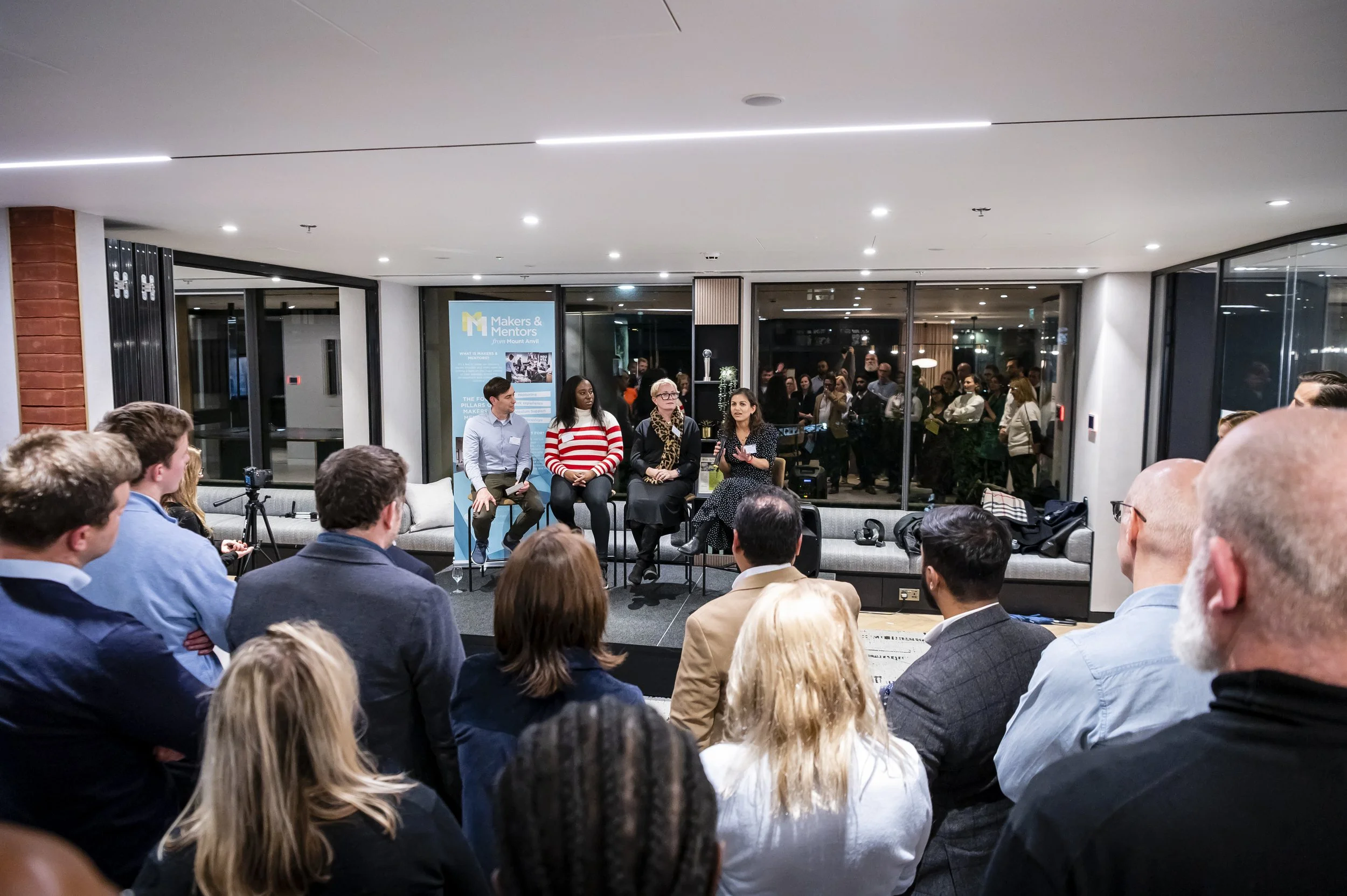
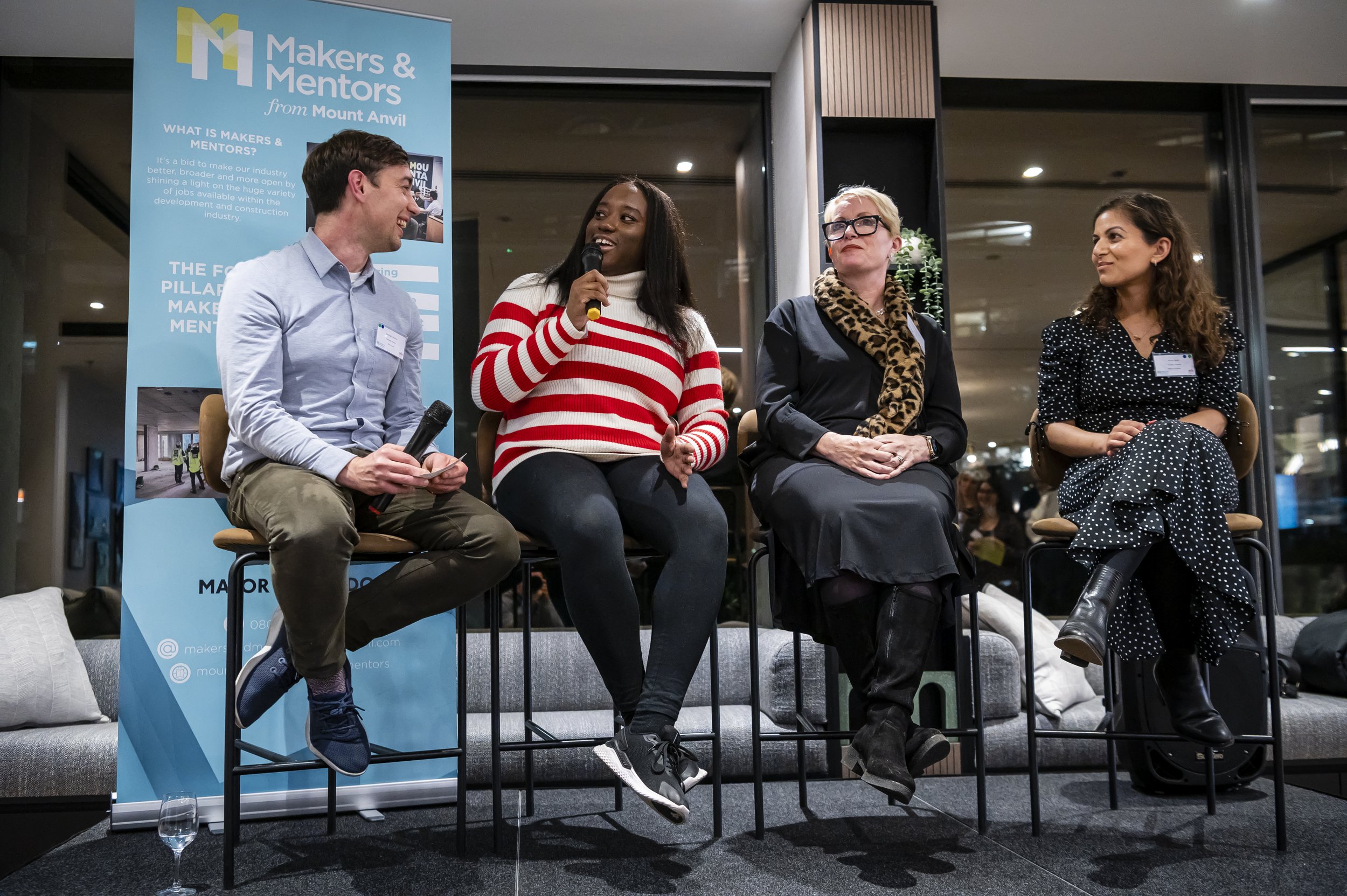
From left to right: Darragh Hurley, MD of Mount Anvil, Sarah Hayford, Founder and CEO of The Land Collective CIC, Fiona Fletcher-Smith, Chief Executive of L&Q and Priya Aggarwal Shah, Founder and Director of BAME in Property at Mount Anvil and BAME in Property’s mentoring event.
Creating Connections mentoring event
For this event we partnered with Mount Anvil and their Makers & Mentors programme, which is backed by the Mayor of London, to bring our networks together, create connections, and ultimately, help people find their perfect mentoring match.
The event, held on 23 November 2022 at Mount Anvil’s Living Room space in their Barbican office, saw Priya Aggarwal Shah, Founder and Director of BAME in Property, Fiona Fletcher-Smith, Chief Executive of L&Q, Sarah Hayford, Founder and CEO of The Land Collective CIC and Darragh Hurley, MD of Mount Anvil, share their words of wisdom about mentoring.
As Sarah Hayford said, “Trying to be something you’re not, doesn’t pay dividends in the long run.”
For Fiona, the importance of “being unashamedly myself” was important and paved the way for her success across the industry.
Meanwhile, Darragh summed it up to a tee, “problems aren’t solved from the consciousness that created them – we need cognitive diversity in order to thrive.”
The mentees in the audience loved the encouragement to stand out, come out of their comfort zone and really see how mentoring can help someone achieve incredible things. No doubt, we are all surrounded by indirect mentors, it only takes some encouragement from one person to help change your mindset and nurture a sense of belief.
The rest of the evening saw people networking and exchanging details before we reconvened to celebrate two years of Mount Anvil’s Makers & Mentors programme with birthday cake.
We obviously thought the evening was fantastic (!) but the true testament was from our attendees who shared how useful they found the networking and the opportunity to speak to people outside of their usual circles. A few people even found their mentoring match! Over the last couple of months, we’ve been following up with our networks to see if they’ve found more mentoring matches and supporting people with their programmes through Makers & Mentors.




Get involved with the Makers & Mentors programme
If you’ve made it this far (thank you!) and are interested in getting involved with the Makers and Mentors programme, please get in touch with us on hello@bameinproperty.com or visit https://mountanvil.com/makers-mentors/mentoring/.
“Everyone has life skills and experience to share as a mentor. One word, one hour can be all that’s needed to effect a positive change in someone.” – Chelsea Baker

Five years of BAME in Property – the personal, professional and industry journey
This week I mark five years of BAME in Property, an organisation I founded and now run full-time, and I’m taking a moment to celebrate this achievement and the journey that got me to this stage. The last five years haven’t just been about personal and professional growth, but it’s given me an opportunity to reflect on how the industry has made progress on ethnic diversity too.
Please note that this article was published prior to the new brand name of PREACH Inclusion® on 25 April 2024, so you will notice references to BAME in Property.
Sometimes we focus too much on chasing the next achievement that we forget to pause, reflect and be grateful for the milestones achieved. This week I mark five years of BAME in Property, an organisation I founded and now run full-time, and I’m taking a moment to celebrate this achievement and the journey that got me to this stage. The last five years haven’t just been about personal and professional growth, but it’s given me an opportunity to reflect on how the industry has made progress on ethnic diversity too.

Priya Aggarwal-Shah
Setting up BAME in Property as a networking group
I started BAME in Property in late 2017 out of a frustration of seeing little diversity at events, panels and in my project teams. Being quite junior in my career as a stakeholder engagement consultant, I was keen to network and build those all-important connections. But going to networking events was daunting. The lack of diversity was one thing, but most of these events were centred around alcohol, which wasn’t always my cup of tea. My day-to-day work involved engaging with diverse communities, but how could we understand their housing needs if we didn’t represent their lived experiences and cultural sensitivities in our project teams? Even on the client side, the lack of diversity was apparent when I got called an ‘Indian Princess’ by someone I worked with. Even if it was supposed to be banter, it was still inappropriate.
There came the idea to create a networking group for Black, Asian and Minority Ethnic (BAME) professionals. Inspired by the success of Charlotte Morphet’s Women in Planning network, I set up BAME in Property to create a safe space for BAME and non-BAME professionals to come together, network, socialise and share their concerns. I’m grateful there was interest from colleagues across the industry who offered support in the early years and beyond – thank you Bhavini Shah, Amrit Singh Bahia, CJ Obi, Zara Din, Abraham Laker and many others for being my sounding boards.
The first couple of years
Following a successful launch event in March 2018, BAME in Property gained traction. There was clearly a gap in the property and real estate market for a group like this and the sponsored events rolled in. We had BECG, K&L Gates, Knight Frank, Cushman & Wakefield and LandSec sponsor major events throughout 2018 and 2019, helping to bring together BAME and non-BAME professionals in the industry together and start the necessary conversation about ethnic minorities often facing challenges in their careers.
“The events were great, but I always wonder what lasting effect they had. Many people still shied away from having the difficult conversations about race, microaggressions and discrimination."
As the face of BAME in Property, the first two years were incredibly busy. I was speaking on a panel event nearly every month, primarily running the social media platforms for the organisation, replying to emails from interested people, and looking for the next sponsor, all while having a full-time job! The advocacy work happened during lunchtimes, evenings and weekends but being in my mid-20s, and hungry to build this organisation, I probably wouldn’t have had it any other way. I was really inspired by all the people I met and all the stories I heard. In establishing a networking group, I built my own network too and met numerous people who opened doors for me.
Dodging the necessary conversations
The events were great, but I always wonder what lasting effect they had. Many people still shied away from having the difficult conversations about race, microaggressions and discrimination. I even met people who couldn’t say ‘Black’ to identify or describe someone who was clearly Black. But how could you have a meaningful conversation without candidly talking about these issues. It wasn’t a lack of desire to effect change, it was lack of understanding and fear of saying the wrong thing; being culturally insensitive. However, it was important to continue the conversation beyond events and establish a community where people could lean on their peers and seek advice and guidance.
COVID-19
Just as we were about to launch in Birmingham in Spring 2020, the COVID-19 pandemic struck, and all in-person events came to a standstill. Having dabbled into online events in the early days of lockdown, I quickly abandoned these, as having our work and social lives online became all too much. Instead, I focused on developing a community online through social media. I ramped up content, blogs and posts across all social channels, resulting in over 374,000 impressions in the first 100 days of lockdown.
But with regards to employee progression, things just slowed down. People got furloughed, promotions went on hold, and we often lost visibility and connections with our colleagues. Not having networking events was challenging because no doubt many people lost out on key opportunities and confidence building, that could have enhanced their careers.
I think that some of the progress we made with promoting diversity in our industry prior to the pandemic somewhat stalled during the lockdown periods.
Black Lives Matter
Then in May/June 2020 we had the tragic murder of George Floyd and the Black Lives Matter movement taking over our screens. What could have been a watershed moment for the industry ended up being rather tokenistic. Many companies put out a black square and statements on social media, without engaging with their Black colleagues for input. More importantly, many companies didn’t check in with their Black colleagues to see how they were doing through this challenging time.
“What could have been a watershed moment for the industry ended up being rather tokenistic."
Admittedly, a lot of companies simply didn’t know what to do. The BAME in Property inbox was inundated with emails from companies asking for help and guidance on how to respond and do better. That’s when I started offering workshops and lunch and learns about ethnic diversity in the built environment.
Commercialising BAME in Property
“I never started my career with the idea of running an EDI company, I kind of just fell into it."
In the midst of the pandemic and the online growth in followers and requests for support, I saw my opportunity to expand BAME in Property’s services and evolve it into a company. In starting this as an extra-circular activity, I quickly realised a growing passion and interest in EDI issues and wanting to make some positive changes. Using my background and skills in comms and PR, I was able to create engaging content, host events, and build an organic social media following of 10,000+. I started small, I launched a Jobs Board, initially asking a few companies how I could operate this to benefit them – the response was a ’hosting platform’, as they wanted potential candidates to end up on their website. So, I did this, and the demand increased. The Jobs Board, alongside the workshops and lunch and learns, was the beginning of BAME in Property Ltd. I never started my career with the idea of running an EDI company, I kind of just fell into it.
Juggling the full-time job, the side job, and my personal life
“I will always look back at 2021 as a year of personal achievements."
The energy I had in my mid-20s to run a side ‘hustle’ alongside a full-time job was starting to chip away. As I progressed in my comms career, naturally my workload and responsibilities increased. 2021 was also the year I was buying a house and getting married, all during COVID-19 lockdowns. To say it was quite stressful was an understatement. I started finding I couldn’t commit as much time to BAME in Property as I would have liked and the resentment towards my main job and my side passion was real. I persevered though and will always look back at 2021 as a year of personal achievements.
Making the side hustle the main hustle
Despite my time being stretched, the need for EDI in the built environment has remained. With no wedding to plan in 2022(!), I could redirect my focus and time to growing BAME in Property Ltd. I spent some of my spare time doing courses on diversity and inclusion on Future Learn. The passion had been ignited again; I just didn’t have the courage to leave my full-time job yet.
“As scary as it was to do this, it was my ‘now or never’ moment to see what I could achieve with this organisation."
A string of conversations inspired me to take that big step. Many people I met already thought I was running BAME in Property full-time, while others kept saying "it’s only a matter of time before you do!”.
Having started commercialising BAME in Property two years ago, in summer 2022, I was finally in a position financially and mentally to take the leap. As scary as it was to do this, it was my ‘now or never’ moment to see what I could achieve with this organisation.
Looking ahead
Now, two months into running BAME in Property full-time, I am truly encouraged and grateful for the support I have received. My clients, previous and current, include the likes of Mount Anvil, Thirteen Housing Group, NLA, Turley, Pocket Living, Forsters LLP, and Trident Building Consultancy, with many others using BAME in Property’s Jobs Board.
Looking ahead, a potential name change is on the cards. When we started five years ago, ‘BAME’ was the known term, but times have changed and even I have disclaimers about the term.
“The last five years have been a journey, I’m excited for the next five."
Utilising my comms background, I will continue to grow BAME in Property online, through engaging content, social media and events. The area that I’m particularly interested in is culturally sensitive community engagement, especially in light of the 2021 Census data. This is a huge growth area and something I have always enjoyed, so watch this space. More about this here.
I love what I do, helping companies in this space, and making a difference.
The last five years have been a journey, I’m excited for the next five.

The 2021 Census data and what it means for the built environment
We are living in a UK which is more racially, ethnically, religiously and culturally diverse than it was in 2011 and this has huge implications for built environment practitioners. It’s not enough to have ethnic diversity as an afterthought in your company organisation and outputs, it must be completely integral to your company policies, your work and how you operate. In this piece, we share some of the key findings regarding minority communities, the impact this will have on the built environment and how BAME in Property can help you.
Please note that this article was published prior to the new brand name of PREACH Inclusion® on 25 April 2024, so you will notice references to BAME in Property.
Throughout November, the Office of National Statistics (ONS) has been releasing data from the 2021 Census. Although early doors with more data to come, the initial results are not surprising when it comes to ethnic minority communities and their growth over the last 10 years. We are living in a UK which is more racially, ethnically, religiously and culturally diverse than it was in 2011 and this has huge implications for built environment practitioners. It’s not enough to have ethnic diversity as an afterthought in your company organisation and outputs, it must be completely integral to your company policies, your work and how you operate. In this piece, we share some of the key findings regarding minority communities, the impact this will have on the built environment and how BAME in Property can help you.
Key findings from the 2021 Census
- One in six people living in England and Wales were born outside of the UK, an increase of 2.5 million since 2011, from 7.5 million to 10 million. Of these, 4.2 million had arrived since 2011, 2.7 million between 2001 and 2010, and 3.1 million before 2001.
- India remained the most common country of birth outside of the UK in 2021 (920,000 people - 1.5% of all residents), followed by Poland (743,000 people - 1.2%) and Pakistan (624,000 - 1.0%).
- 59.1% of the people of Leicester are now from ethnic minority groups, a major change since 1991, when black and minority ethnic people made up just over a quarter of the city’s residents. Leicester’s Asian population first became well established after 20,000 people settled in the east Midlands manufacturing city after expulsion from Uganda in 1972.
- Minority ethnic people also make up more than half the population in Luton (54.8%) and Birmingham (51.4%), the UK’s second largest city where 20 years ago seven out of 10 people were white. Since the second world war, Birmingham’s population has grown with immigration from the Caribbean and south Asia, as well as Gujaratis who had been in east Africa.
- The census revealed a 5.5 million drop in the number of Christians and a 44% rise in the number of people following Islam. It is the first time in a census of England and Wales that less than half of the population have described themselves as “Christian”.
So, what does this mean for the built environment?
No doubt, there is a huge role for planning and engagement professionals to tackle racial inequalities and differences in housing and living arrangements across ethnic communities. This could be better consideration to design needs, layouts, as well as thinking about language translation and engagement with community and ethnic minority leaders. Gone are the days of town hall or even online exhibitions, it's time to think more creatively and inclusively.
“Current retirement living housing doesn't always suit ethnic minority communities. Sometimes there are no vegetarian or Halal kitchens, or carers who speak the native language. Most are located by churches but not temples or mosques."
Different cultures and communities live in different ways. In many regions in Asia, Africa and Eastern Europe, multigenerational living is the norm. But our new builds are usually smaller (and more expensive), hardly accommodating larger families. Additionally, most new homes have open plan kitchens, but in many cultures, there is a preference to separate the kitchen from the living area, to reduce cooking odours spreading. These aren’t just cultural differences but a different way of living that can’t be ignored.
Planning and engagement consultants will need to start incorporating design workshops into their programmes, to really understand design specifics and preferences, which can enhance developments, bring communities on board, and in due course, result in better housing.
Finally, current retirement living housing doesn't always suit ethnic minority communities. Sometimes there are no vegetarian or Halal kitchens, or carers who speak the native language. Most are located by churches but not temples or mosques. Whilst multigenerational housing is common amongst some communities, with smaller housing and more assimilation to Western norms, living arrangements in South Asian communities are changing. But cultural differences will need to be reflected in retirement living complexes to ensure they are meeting different communities’ needs.
Ultimately, this all comes down to the housing allocation in Local Plans, which will likely need a rethink to ensure we are serving diverse communities better.
“You can only implement inclusive designs if you have diverse teams and embrace inclusivity in your organisations."
How can BAME in Property support you
There are many organisations out there who are already implementing better planning and engagement strategies. But, if this data feels a little overwhelming, we at BAME in Property are here to help. Here’s how:
- Want to know more about the challenges and inequalities facing ethnic minority communities with housing and how to engage better with them? We hold a workshop on this very topic and have delivered it to Homes England, Pocket Living, Thirteen Housing Group, The Planning Inspectorate, and to students at UCL, Birmingham and Hertfordshire, to name a few.
- We help organisations reach different audiences through sensitive approaches, which consider ethnic and cultural differences. This could be liaison through a community or religious leader to help understand nuances within a group and to build that all-important trust or reaching out to hyperlocal publications and radio stations to ensure key messages are reaching the communities that need to hear them. We’re passionate about communities having their say, resulting in better relationships with developers. We’re currently working with Thirteen Housing Group on design workshops with the Indian and Pakistani communities in Kirklees, to ensure their housing their needs and culture are incorporated into the plans.
- You can only implement inclusive designs if you have diverse teams and embrace inclusivity in your organisations. If we can support you with EDI challenges or help you advertise roles to some different and ethnically diverse audiences, please get in touch.
Email Priya.shah@bameinproperty.com to chat to us about how we can support you. More information on our Services page here.

Do you speak 'town planning'?
Also known as ‘Urbanist on a mission’ on Instagram, Mahsa Khaneghah uses her platform to educate others about town planning in an interesting way, helping to break down the jargon, commonly used in the sector. It’s time to move away from ‘bricks and mortar’ and treat urban planning as the holistic area that it is – from climate change to health inequalities, Mahsa is on a mission to change perceptions about town planning, one Instagram post at a time.
This week we have Mahsa Khaneghah, Head of Planning and Sustainability at Platinum Property Partners, share the importance of language when communicating about the built environment sector to the next generation. Also known as ‘Urbanist on a mission’ on Instagram, Mahsa uses her platform to educate others about town planning in an interesting way, helping to break down the jargon, commonly used in the sector.
It’s time to move away from ‘bricks and mortar’ and treat urban planning as the holistic area that it is – from climate change to health inequalities, Mahsa is on a mission to change perceptions about town planning, one Instagram post at a time.
I’ve always been so excited by place. ‘Where am I?’, ‘What is this?’, ‘Why is it here?’, ‘Who is it for?’. The benefits and negative consequences of planning outcomes are enormously impactful on our lives, economies, planet and culture; yet for the average person the influence of the planning system can be completely undetected.
Growing up multilingual, Urban Planning for me was like finding a language I could communicate the importance of interconnected thinking for place-shaping. Section 2 of the National Planning Policy Framework begins ‘the purpose of the planning system is to contribute to the achievement of sustainable development’ — what a powerful and important statement. So, in theory, the planning system is oriented to achieve balanced spaces, places and communities – but is that how it’s perceived?
“I’ve frankly never met anyone outside of the industry who naturally associates town planning with climate change action or addressing inequality."
Throughout my career I have often had to explain what it is that I do as a Chartered Town Planner and how the planning process works (usually beginning ‘Have you ever played Sims…?’). For those that have encountered planning, a wave of frustration usually bubbles to the surface; and I’ve frankly never met anyone outside of the industry who naturally associates town planning with climate change action or addressing inequality.
Our health is determined by air-quality control and mitigation; the schools and jobs we apply for are influenced by how accessible they are; our moods and ecosystems are impacted by the amount of nature we are exposed to; the colours, shapes and scale of our buildings tell the story of who we were for generations to come; and don’t even get me started on housing quality and delivery! Despite this, the planning process remains enigmatic and unwelcoming to the masses. This highly technical and political space can appear exclusive, be too costly or time-intensive- and that’s for those who are in the position to entertain seeking planning permission to begin with!
In response, I started my Instagram @urbanistonamission over three years ago with the post below:
‘Alexandra Park and Palace in North London is a great example of culture and nature coming together with amazing views of the city! Alexandra Palace station keeps in theme with bicycle storage, recycling bins and lots of green plants and art 💪🏽. This makes for a perfect day out in London, and offers an example of how we can create an emotional connectedness to nature for more sustainable development in overground stations and cultural sites 🏙🌳💚 This is a critical asset for connecting Haringey’s diverse dwellers to the natural environment, where in 2011 over 65% of the population was non-White British! GO PLAY☀️’

Mahsa’s Instagram page, @urbanistonamission
Over 150 posts later and some evolution, I’m still taking pictures and writing about how interconnected thinking across planning principles applies to us all every day.
“My hope for the planning industry is that the process becomes more concise and focused in a meaningful way so that we can all speak ‘Town Planning’."
As the Head of Planning & Sustainability of a nation-wide property franchise, Platinum Property Partners, I regularly support our network and present up and down the country about key legislative changes and sustainable development. The goal is to empower people to engage with the intricacies of planning and the reality of environmental pressures so that they can strategise accordingly.
In a similar vein, @urbanistonamission is about reminding people that sustainable urban development is about everything and everyone. My hope for the planning industry is that the process becomes more concise and focused in a meaningful way so that we can all speak ‘Town Planning’. The push towards sustainable urban development needs to be understandable, achievable and ultimately support those in the industry who are passionate about making a difference – but may struggle with a ‘Town Planning’ language barrier.

Islamophobia Awareness Month – how you can make a difference
Islamophobia Awareness Month (IAM) occurs in November and is a campaign founded in 2012 by a group of Muslim organisations. It aims to showcase the positive contributions of Muslims as well as raise awareness of Islamophobia in society.
In this blog, we discuss the many types of Islamophobic behaviours which could occur within the workplace and how you can take a stand, to make your Muslim colleagues feel more included and comfortable.
Islamophobia Awareness Month (IAM) occurs in November and is a campaign founded in 2012 by a group of Muslim organisations. It aims to showcase the positive contributions of Muslims as well as raise awareness of Islamophobia in society. This year, as we mark 10 years of IAM, the theme is #TacklingDenial. The denial of Islamophobia can be seen in many forms in both political and social spaces. Why is tackling denial important? Because if you allow people to deny the very existence of Islamophobia, how can we begin to have a sensible conversation about it and therefore tackle this problem? Denial simply shuts down this conversation.
In this blog, we discuss the many types of Islamophobic behaviours which can occur within the workplace and how you can take a stand to make your Muslim colleagues feel more included and comfortable.
To begin, it’s so important we define Islamophobia:
“Islamophobia is rooted in racism and is a type of racism that targets expressions of Muslimness or perceived Muslimness.” - APPG on British Muslims
There are many types of Islamophobia, such as verbal and physical attacks, which are frequently reported in the media. But this is only the tip of the iceberg, and the majority of Islamophobic traits are less visible, such as discrimination, stereotypes, exclusion and marginalisation, often issues which can occur in the workplace.
Research by MEND (Muslim Engagement and Development), a charity that seeks to tackle Islamophobia in the UK, found that those who appear visibly Muslim, such as women who wear the hijab or niqab, are likely to be targeted with both overt and covert forms of Islamophobia.
Often, we don’t realise the hidden forms of Islamophobia that takes place in the working environment. Here’s some examples:
- Making assumptions about religious festivals, such as Ramadan and Muslim’s who are fasting, not fasting and choosing not to fast.
- Refusing flexible working and annual leave requests during religious festivals.
- Not providing a safe space for prayer but then asking for workers to return to the office.
- Treating someone differently and discriminatory because they wear a headscarf or niqab.
- Only holding drinking socials and thereby indirectly excluding some Muslim colleagues from taking part, who may feel uncomfortable in attending these events.
- When holding team meals, you feel that providing Halal food is an inconvenience.
While many companies have made progress in policies and events for their Muslim employees, there is a still a long way to go in ensuring a truly inclusive and Islamophobic-free workforce. An article in The Independent last year talked about the negative experiences of Muslim women in society and how they are frequently targeted and treated differently for their beliefs. One lady stated:
“I conformed, and I fitted in. I drank alcohol, I dressed the way everyone else dressed. But as soon as I put the hijab on everything changed.”
Without realising it, many people are unconsciously bias towards Muslim individuals, impacting their career progression, mental health and day-to-day interactions.
How you can make a difference
So, what can you do to ensure we are #tacklingdenial about Islamophobia and ensuring your Muslim colleagues feel welcomed and included.
- Education over ignorance. Like with most things, we truly believe in the power of education. A large part of this is learning about Islam, the festivals, the principles and how this guides someone’s appearance and values, such as not drinking alcohol. Be curious, but not ignorant. After all, you can find out anything on Google.
- Diversify your social events. Not all socials have to be centred around drinking. This not only alienates some Muslims but pretty much anyone who doesn’t drink or who feels uncomfortable around alcohol.
- Provide a quiet and private space for prayer. This is particularly important if you have a working policy swayed more towards being in the office. Ensure the prayer room is labelled clearly and isn’t changed into a meeting or other type of room at short notice.
- Respect flexible working requests. Be sure to honour and allow more flexible working during certain religious periods, such as Ramadan, where fasting patterns require more flexibility.
- Invest and act on anti-racism/Islamophobic training. Often being on the EDI journey is recognising that ‘you’ve not cracked everything’ and that there’s still a long a way to go. Accept that there may be times when uncomfortable training, such as anti-racism, may be necessary to help understand unacceptable behaviours.
We’ve discussed many of these areas before, take a look at our Ramadan blog for more specific support during Ramadan and our Inclusive actions blog about other measures to implement and create a more comfortable working environment.
According to data from the Office of National Statistics (ONS), in 2018, there were nearly 3.4 million Muslims recorded in the UK, making up around five per cent of the total 67.2 million population. This is no small figure and in order to reduce Islamophobia in the UK, more work needs to be done in workplaces to include our Muslim colleagues and ensure they feel safe and comfortable.
To speak to BAME in Property about our inclusion policies, please email hello@bameinproperty.com.

Black History Month special, In conversation with Hanna Afolabi, Founder of Mood and Space
To mark Black History Month (BHM) 2022, Founder of BAME in Property, Priya Aggarwal-Shah caught up with Hanna Afolabi, who recently launched her new development and ESG business, Mood and Space (MAS).
Please note that this article was published prior to the new brand name of PREACH Inclusion® on 25 April 2024, so you will notice references to BAME in Property.
To mark Black History Month (BHM) 2022, Founder of BAME in Property, Priya Aggarwal-Shah caught up with Hanna Afolabi, who recently launched her new development and ESG business, Mood and Space (MAS). Prior to entering the world of entrepreneurship, Hanna enjoyed a successful career as a Development Director for Balfour Beatty Investments and at Linkcity (Bouygues Developments), focusing on the Canning Town regeneration project. She is also founder of Black Women in Real Estate and part of the Property Development Book Club. In September 2022, Hanna was named as one of EG’s Rising Stars.
A force of nature, Hanna is spreading her wings across the built environment sector. Read on to find out how she ended up with her own venture, Mood and Space.
East London through and through
Hanna was born and raised in East London; she spent her childhood years in Hackney, went to secondary school in Tower Hamlets and to college in Leyton. Following her degree in Architecture at Sheffield University, Hanna rented a property in East Village, Stratford with her sister. Through renting a Get Living property herself, Hanna sparked an interest in BTR. She described how ‘tenure blind’ worked well in this property, enabling people from different backgrounds to live together.
Nevertheless, the low availability of plantain was an issue in East Village for Hanna! She said, “when looking for a property with my husband, access to plantain, along with West African spices, peppers and culture was a key requirement,” demonstrating the importance of ethnicity and culture when looking to establish your feet somewhere.
Although East London is very diverse, Hanna explained how she felt the shops in East Village were very Western and didn’t necessarily serve the Afro-Caribbean population.
“Over time New Stratford has become increasingly gentrified, despite pre-existing residents often being from lower socio-economic backgrounds. The new neighbourhood was for new people, rather than integration with former residents.”
A varied and successful career
Hanna’s first job was in Lagos, Nigeria, where she worked as an Architectural Assistant. “One of my clients was Standard Chartered Bank and I had lots of opportunities to work on site and refurb their branches.” Although Hanna was exposed to many aspects she learnt in her Architecture degree, she wished she had the opportunity to work on sites sooner, stating “it helped to bring the classroom to life.”
While Hanna enjoyed her work in Lagos, she preferred the project management side of it more, rather than the architecture. After working in Nigeria for nearly a year, Hanna returned to the UK and worked for Peabody Housing Association as a development officer. This was her introduction to development and regeneration. At Peabody, Hanna worked on the Borough Triangle in Elephant and Castle, a project, which consisted of two 30+storey blocks and what was to be Peabody’s new head office.
Following this, she moved onto Linkcity (Bouygues), where she worked in a development management capacity. Here, Hanna worked on the Canning Town town-centre regeneration – Hallsville Quarter, involving the build of 1,000 new homes and 20,000 sqm of commercial, office and student accommodation.
Working in Canning Town was all too familiar to Hanna, having grown up and lived in several other parts of East London already. *“The area had changed so much since the time my friend lived there. It was nice to be back in East London, working on a project which was investing in the local area.”
Hanna then moved onto Balfour Beaty Investments, where she worked at for four years on the East Wick and Sweet Water project, leading on the feasibility, business planning, budget, design, programming and planning of the mixed-use regeneration project of c.1,900 homes on the Queen Elizabeth Olympic Park.
As Hanna had worked within the Olympic Park for several years, I was keen to hear her views on its legacy.
“[The Olympics] were an amazing investment for London but not much of the investment benefited local people. In the ten years prior to the Olympics, Hackney (one of the legacy boroughs) was not adequately invested in and having lived in the borough at the time, it meant poor housing. Now, ten years later, the demographic has completely changed, and I think this is because the people who made the decisions about the legacy of the Olympics were not representative of local people, they have no lived experience of those communities.”
Extra-curricular activities
During her time at Balfour Beaty Investments, Hanna set up Black Women in Real Estate in November 2019, a safe space for Black women to connect and create a supportive network across the industry.
In her bid to set this up, Hanna literally searched for Black women on LinkedIn to invite to a dinner. That’s how the first 15 members were established.
“It was nice to sit and chat with other women who understood the nuances of my experiences and career.”
Following the initial dinner, the BWRE network started meeting regularly. During the COVID-19 lockdown, the group moved to online monthly calls, which then increased to fortnightly after the George Floyd murder, as members were discussing how their companies were responding to this.
Fast-forward three years and BWRE have a few partnerships, including with Space Plus, a global industry conference provider and enabler. Through this partnership, BWRE attend their events and push for further representation at their events – not just women speaking about diversity but for their expertise too.
“We want to humanise EDI and get people to understand that people are just trying to thrive.”
BWRE recently shared their #Iamwomen campaign, highlighting Black women in the industry.
As if BWRE wasn’t enough, during lockdown, Hanna became a founding member of the Property Development Book Club. What initially started as a ‘clubhouse’ chat with 1,000+ participants, has now evolved into a podcast created by developers, proptech experts, quantity surveyors and architects. The first season of the podcast has just been released.
Launching Mood and Space
After a successful decade of working in the industry, in summer 2022, Hanna took the decision to launch Mood and Space, a new development company that supports clients in embedding social value in their development vision and strategy, as well as managing the processes to deliver community focused buildings and neighbourhoods.
“Being an ambitious person, I’ve always wanted to own or lead a company… I thought it would happen later in my life but being a woman, I had to consider how my career would sit beside having a family. This was my ‘now or never’ moment. I’ve learnt and achieved a lot and I have gained the necessary skills. The autonomy and freedom of running my own business fuels my passion.”
Hearing this, it was evident that Hanna knows what she wants. Indeed, we discussed that setting off on your own to run a business wouldn’t be possible without self-belief.
“You have to be mentally secure in yourself to be able to push forward.”
Recognising Hanna’s achievements
Hanna’s successful career and empowering extracurricular activities have not gone unnoticed. She was recognised as one of EG’s Rising Stars 2022 and was a Black British Business Awards 2022 Rising Star finalist. This year she was also listed as Bisnow’s 41 Women in UK Real Estate. Last year she was winner of the We Are the City Rising Star 2021 in Infrastructure, Transport & Logistics.

The Power of Now: How to implement inclusive policies within the workplace
National Inclusion Week takes place from 26 – 30th September and this year’s theme is ‘Time to Act: The Power of Now’. Often, Equality, Diversity and Inclusion (EDI) policies can take a while to implement and genuinely see results. With this in mind, we’ve set out some tangible actions which can demonstrate action and results from the get-go. From diversifying social events to doing a website audit, we truly believe that small steps can make all the difference, heading in the direction of creating a more comfortable and inclusive working environment.
Please note that this article was published prior to the new brand name of PREACH Inclusion® on 25 April 2024, so you will notice references to BAME in Property.
National Inclusion Week takes place from 26 – 30th September and this year’s theme is ‘Time to Act: The Power of Now’. Often, Equality, Diversity and Inclusion (EDI) policies can take a while to implement and genuinely see results. With this in mind, we’ve set out some tangible actions which can demonstrate action and results from the get-go. From diversifying social events to doing a website audit, we truly believe that small steps can make all the difference, heading in the direction of creating a more comfortable and inclusive working environment.
1. Ensure senior leaders support your EDI efforts
EDI needs to be within the roots of a company, rather than an add on – it should guide every policy within the workplace, from culture, pay, recruitment strategy and flexible working – to name a few. If senior leaders aren’t pushing for this, it’s very difficult to implement any tangible policies.
2. Rotate who runs and drives meetings
‘Diversity is being invited to the party; inclusion is being asked to dance.’ Most companies run team meetings, usually led by the same person and often this one individual can dominate the agenda and conversation. One way of creating more inclusivity is to rotate who runs the meeting to enable colleagues to exert different approaches and personalities. This can lead to more ideas and ultimately more creativity. It’s also important for building confidence for those who typically don’t speak and enables them to feel more included.
"Asking for flexible working during Ramadan becomes much easier when everyone has received an e-newsletter about it."
3. Diversify your social events
When you’re planning your next social event, perhaps it’s time to do something different. Not all events need to involve alcohol, as this can isolate those who choose not to drink or don’t feel comfortable being in that environment.
And have you noticed some people consistently aren’t able to make social events due to other commitments? Think about timing of your next event, perhaps even doing it during working hours to enable everyone to take part.
4. Celebrate some different cultural and religious events
Download a festivals calendar and pick a few key events you could celebrate or highlight throughout the year. This not only raises awareness and educates colleagues, but it can often make what appear to be difficult conversations, much easier. For example, asking for flexible working during Ramadan becomes much easier when everyone has received an e-newsletter about it.
Celebrating different festivals also breaks down barriers and biases that people inherently have – it’s the start of creating an open-minded culture for the future of the company.
5. Organise a website audit to ensure it reflects diversity
‘Your vibe attracts your tribe’. If your company website is only showing one type of person, this won’t excite people from more underrepresented backgrounds to want to join. With it being the first port of call for research on a company, put your best foot forward and ensure your showing diversity in images, different levels within the organisation, voices and content from individuals across the whole company, not just the senior leadership team.
Gen Z are increasingly looking for a company’s EDI policy on the website, so have a page about this too and be honest about the journey – people like the candidness.
Sometimes it’s easier to have an external consultant critique your website than it is from within your company. Consider speaking to an organisation like BAME in Property to help you with this process.
"Just like good work is rewarded, best practice for the company should be recognised and acknowledged in annual appraisals and feedback from leaders."
6. Ask for feedback from your employees
Regularly gather feedback and share results at the team level. When company leaders are consistently open to receiving feedback—constructive and positive—the door to achieving substantive progress is opened.
7. Recognise inclusive behaviours
In many organisations, EDI policies are suggested within an internal diversity or working group. The burden of executing this shouldn’t fall on your employees, but where employers have taken an active role in internal working groups, led on a cultural event or taken time to drive an EDI policy, this should be rewarded. Just like good work is rewarded, best practice for the company should be recognised and acknowledged in annual appraisals and feedback from leaders.
These are just some of the measures you can implement immediately to start creating a more inclusive culture. Need help with any of these? Get in touch with BAME in Property to see how we can support you on your EDI journey.

BAME in Property calls for mandatory ethnicity pay gap reporting
At BAME in Property, encouraging the built environment sector to report on the ethnicity pay gap is a priority. In this piece we discuss the moral and financial reasons for reporting on this.
However, we also recognise some of the challenges around ethnicity pay gap reporting. Taking guidance from the House of Common’s Women and Equalities Committee and our own resources, we want to support and encourage the built environment sector to consider releasing this data even without it being mandatory.
Please note that this article was published prior to the new brand name of PREACH Inclusion® on 25 April 2024, so you will notice references to BAME in Property.
Following this year’s International Equal Pay Day (18 September), we’re calling on the Government to make ethnicity pay gap reporting mandatory. While the day has traditionally focused on gender pay gap elimination, we know that in the UK, pay gaps between ethnic minorities can be high and that it’s important to acknowledge and act on these too.
However, we also recognise some of the challenges around ethnicity pay gap reporting. Taking guidance from the House of Common’s Women and Equalities Committee and our own resources, we want to support and encourage the built environment sector to consider releasing this data even without it being mandatory.

Where are we now
In February 2022, the Women and Equalities Committee, recommended that ‘reporting the ethnicity pay gap should be mandatory, and is the first step to addressing pay disparities between employees from different ethnic backgrounds.’ The Committee called on the Government to introduce legislation which would require large companies to publish their ethnicity pay gap data.
In response, the Government stated it would not be making ethnicity pay gap reporting mandatory “at this stage”, to avoid burdening workplaces during their post-pandemic recovery. Despite stating that such reporting would be an effective tool to assist employers in making a fair workplace, the Government has stated it may not be suitable for all workplaces.
In 2017, as part of the Equality Act 2010, the Government introduced mandatory reporting on the gender pay gap for all companies with more than 250 employees. The result has been companies reporting these figures annually, a national archive of data and solutions to move forward, where gaps are identified.
By comparison, the Office of National Statistics (ONS) has only released official statistics on ethnicity pay gaps twice since 2019, with the last time being in 2020. Since then, we have had the COVID-19 pandemic, which has disproportionately impacted ethnic minorities, their employment status, and opportunities, and as a result, their pay. No doubt, mandatory reporting would allow us to collate data, which could be helpful in responding to such societal events.
"Many people are now calling for ethnicity pay gap reporting to become mandatory for all companies with 250+ employees... to reduce injustices between BAME and non-BAME workers."
The argument from the Women and Equalities Committee is that companies which are already reporting on gender pay gap, will have some practices in place to support with ethnicity pay gap reporting.
In recognition that the built environment industry also lags behind when it comes to ethnic diversity, Cushman & Wakefield has for the last few years, voluntarily published its mean ethnicity pay gap, with reductions in the gap from 29.4% in 2020 to 26.9% in 2021.
Many people are now calling for ethnicity pay gap reporting to become mandatory for all companies with 250+ employees, in a bid to encourage them to take tangible action to reduce injustices between BAME and non-BAME workers.
The challenges
Even though many companies will already be reporting on gender pay gap, we acknowledge one of the biggest challenges being data collection for ethnicity pay gap reporting. Many ethnic minorities are reluctant to disclose personal information about their ethnicity and religion, often fearing that this could be a hindrance in their progression within a company. Lack of or incomplete data would distort the results and its effectiveness.
"The real question we should be asking is whether a BAME person and a white person in the same client-facing role are earning the same."
You only have to take a look at the industry to see the complete lack of diversity within companies at senior levels. The perception this gives is that ethnic minorities are less likely to be considered or put forward for such positions. As a result, many people would rather keep their ethnicity to themselves to even make it beyond the recruitment screening process.
No doubt a continuous communications campaign will be necessary, explaining why the data collection is happening, what it will be used for and how it will guide future pay and policies. This complete transparency will help people be more willing to disclose their personal information.
Unlike gender pay gap reporting, which is quite binary, ethnicity pay gap reporting is far more nuanced. Within the BAME umbrella, different ethnicities do better than others. Focusing on ONS’s 2019 data, the Bangladeshi (£10.58 per hour) and Pakistani (£10.55 per hour) ethnic groups had some of the widest positive pay gaps, respectively earning 15.3% and 15.5% less than White British employees (£12.49 per hour). Those found to earn more included: White Irish by 40.5% (£17.55 per hour), Chinese by 23.1% (£15.38 per hour) and Indian by 15.5% (£14.43 per hour). As such, ethnic pay gap reporting is important for understanding the differences within the umbrella term, ‘BAME’, as well as within white counterparts.
There is also the issue of back office and client facing roles. The reality being that ethnic minorities, on balance, tend to have more back-office positions, such as in admin or finance. Companies might be able to meet an ethnicity pay gap quota through such positions. However, the real question we should be asking is whether a BAME person and a white person in the same client-facing role are earning the same.
Why it's important
The challenges should not be a reason to stop the built environment sector in tackling the ethnicity pay gap but an opportunity to be more inclusive. This is not just an issue for ethnic minorities as the ethnicity pay gap affects everyone.
"We want your talent and skills, but we don’t think you should be earning the same as your white counterparts."
It is extremely discouraging for prospective BAME professionals looking to enter an industry to see that there is a substantive ethnicity pay gap. They are already questioning their value, worth and ultimately, their place in the company. Companies could miss out on vital talent and diversity in thought, crucial for any sector to continue thriving.
Putting aside the talent argument for ethnicity pay gap reporting, at the very least, it is morally right to pay two people doing the same job, the same amount. Companies that do not are essentially classifying BAME professionals as second-class workers, suggesting ‘We want your talent and skills, but we don’t think you should be earning the same as your white counterparts.’
"Companies with greater ethnic and cultural diversity outperform their competitors by 36%... it’s not just morally right, it makes financial sense. "
Ultimately, companies will financially benefit from diverse talent. McKinsey’s Report, ‘Diversity wins: How inclusion matters’, demonstrates how companies with greater ethnic and cultural diversity outperform their competitors by 36%. The likelihood of outperformance continues to be higher for diversity in ethnicity than for gender. As such, it’s not just morally right, it makes financial sense.
Key recommendations
The Women and Equalities Committee has recommended the Government introduces mandatory ethnicity pay gap reporting by April 2023 for all organisations that currently report for gender. Legislation should include the requirement for employers to publish a supporting narrative and action plan. To accompany this, the Government should produce guidance, with clear explanations on:
- data protection to reassure employers how they can legally capture, retain and report ethnicity pay gap data;
- methods for capturing, analysing and reporting ethnicity pay data; and
- the body responsible for enforcement and what powers that body will have.
At BAME in Property, encouraging the built environment sector to report on the ethnicity pay gap is a priority. We want current and future generations entering the industry to see that equal pay is a priority and that it is an inclusive industry to work in.
Our Corporate Members will be discussing this issue at a high-level, sharing ideas and best practice on how to approach this task. This is not a competitive process, as no company can whole-heartedly admit that they have eliminated the ethnicity pay gap. Rather, collaboration will be encouraged, as the whole industry needs to improve.
It won’t be an easy task, but it is necessary. We are calling on the Government to make ethnicity pay gap reporting mandatory.
Email hello@bameinproperty.com if this is something we can support you with.

Comment: Will blind CVs help diversify your company's recruitment?
One of the most common recruitment questions we get asked is whether companies should engage in blind hiring processes. Companies often implement a blind CV process to remove unconscious biases from recruitment managers. The result can be a more diverse pool of candidates during the interview stage and ultimately, employees within the company, if hired.
At BAME in Property, we’ve considered the impact of blind CVs to help you make the right decision with your recruitment process.
Please note that this article was published prior to the new brand name of PREACH Inclusion® on 25 April 2024, so you will notice references to BAME in Property.
One of the most common recruitment questions we get asked is whether companies should engage in blind hiring processes. Companies often implement a blind CV process to remove unconscious biases from recruitment managers. With the industry becoming increasingly competitive and candidates having more choice, it's important companies consider a multitude of hiring procedures. Blind CVs can result in a more diverse pool of candidates during the interview stage and ultimately, employees within the company, if hired.
However, there are some drawbacks of blind CVs, the primary one being it doesn't prevent unconscious bias once a candidate gets to the interview stage. There is also a question about whether it is morally right to remove someone's personal details.
At BAME in Property, we've considered the impact of blind CVs to help your recruitment decisions.
So, what exactly is a blind CV? It is the basis of blind hiring, and a CV that doesn't have any identifying factors. This includes things like a candidate's name, gender, age, or race. The long and short of it is that there is no information present that isn't related to the candidate's working capabilities.
A more diverse talent pool
The most obvious benefit of blind CVs is the prospect of hiring talented people, who wouldn't normally make it through the interview process. As people are inherently bias in their selection process - e.g., choosing someone based on where they live or where they schooled - removing this detail focuses the hiring manager to select someone on their abilities and competencies.
A BBC Inside Out London investigation in February 2018, found that two CVs containing the same employee and educational information but different names, Adam and Mohammed, resulted in Adam receiving 100 interviews and Mohammed only 12, suggesting an obvious bias in the recruitment process. A blind CV process in this situation could have offered Mohammed more interview opportunities.
Many companies have been implementing blind hiring processes for years, including EY, which has removed details such as name and education – opening the doors for more state-schooled candidates. The result has been more people from non-traditional backgrounds entering the firm and progressing just as well.
Thus, there are some obvious internal benefits of blind CVs. From an external perspective, it shows prospective candidates a commitment to diversity and that a company cares about eliminating discrimination, where possible.
A short-term fix, not a long-term solution
"Why should personal details, such as names or schools be removed from CVs to protect a company’s unconscious bias?"
Nevertheless, blind CVs can only go so far. There is a moral argument here that questions why should personal details, such as names or schools be removed from CVs to protect a company’s unconscious bias? When names are removed this is taking away someone’s identity, their heritage and culture. It's the most basic foundation of an individual. If a hiring manager was not going to put someone through an interview process due to their name, age or any other personal information, why should that person work for said company anyway? In fact, they probably wouldn't want to work in that environment either if these biases come to surface once an individual joins the company – unfortunately, this happens all too often when people from ethnic backgrounds are treated differently. Indeed, this can even happen during the interview process, when hiring managers come face-to-face with candidates and biases start creeping in.
"When names are removed this is taking away someone’s identity, their heritage and culture. It is the most basic foundation of an individual."
Furthermore, blind hiring can in fact do the opposite of what it seeks to achieve and rather, hinder diversity in hiring. Many employees seek out minority candidates during the hiring process to engender positive action. This is defined as taking measures to support the recruitment of underrepresented minorities. However, when recruiters do not have candidates’ information, they cannot pursue diversity.
The reality is that we all have unconscious biases, regardless of which background we are from. Naturally, we are attracted to people who look and talk like us and have similar life experiences to us. Thus, whilst we can't remove unconscious bias, we can foster a more open and inclusive culture, which appreciates and welcomes differences. This is a longer-term solution which benefits everyone, rather than creating a short-term fix that may not last once an individual has joined a company.
"blind CVs in isolation is not the solution to a better hiring process but must be in conjunction with culture training and other initiatives."
A more inclusive culture can spark better conversation during the interview process and anticipate certain questions, such as flexible working requests during religious holidays or interests outside of work.
The point being, blind CVs in isolation isn't the solution to a better hiring process but must be in conjunction with culture training and other initiatives which promote diversity.
Get in touch with us to discuss how we can help create a more open and inclusive culture within your company.
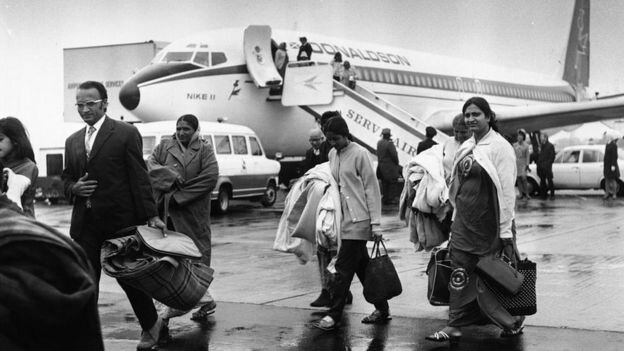
South Asian Heritage Month special – Marking 50 years of the contributions of Ugandan South Asians in the UK
For this year’s #SouthAsianHeritageMonth, we celebrate the stories of resilience and tenacity of the Ugandan Asians who came to the UK in the toughest of circumstances but who overcame adversity – not just for themselves but for their community too. BAME in Property committee member and Partner at Montagu Evans, Bhavini Shah, explores the influence of Ugandan Indians in the UK, especially Leicester.
This year marks 50 years since Ugandan Asians were expelled from Uganda. More than 27,000 Asians were expelled by Ugandan dictator Idi Amin in 1972 and thousands settled in Leicester. For this year’s #SouthAsianHeritageMonth, we celebrate the stories of resilience and tenacity of the Ugandan Asians who came to the UK in the toughest of circumstances but who overcame adversity – not just for themselves but for their community too. Head of Diversiy, Equity and Inclusion (DE&I) at Montagu Evans, Bhavini Shah, explores the influence of Ugandan Indians in the UK, especially Leicester.

Ugandan Asian refugees arriving on a special charter flight at Stansted Airport in Essex, 18th September 1972 / Keystone / Hulton Archive / Getty Images
On 4 August 1972, Idi Amin, President of Uganda from 1971 to 1979, ordered the expulsion of Uganda’s South Asian minority, giving them 90 days to leave the country, accusing them of “sabotaging Uganda’s economy and encouraging corruption”. Although they formed the minority of the country’s population, it is important to note that official figures suggest that the Ugandan Asians contributed to circa 90% of Uganda’s tax receipts in 1972.
Estimates of the total number of Ugandan Asians expelled from Uganda varies, ranging between 55,000 and 80,000 people, with the number of people coming to the UK around 27,000. Ugandan Asians were pretty-much stripped of their assets and possessions with people even reported being held at gun point by officers before leaving the country to take valuable personal possessions.
"Though Amin took their possessions, they had not lost their skills, university degrees or network of community contacts that would see many of their businesses rise from the ashes. They helped each other to help themselves."
A BBC article from 18 September 1972 reports on the first 193 Ugandan Asians arriving into Stansted Airport that very morning. Some had made their own arrangements with family and friends whilst others were taken to an RAF camp at Stradishall in Suffolk, which was organised by the UK Ugandan Resettlement Board. The families who arrived mostly settled in already established communities in areas such as London and the East Midlands with most Ugandan Asians (around 20,000) settling in Leicester.
It is in business that Ugandan Asians have made the biggest impact because that is where most of their success in Uganda lay. They were highly educated and familiar with British customs. Though Amin took their possessions, they had not lost their skills, university degrees or network of community contacts that would see many of their businesses rise from the ashes. They helped each other to help themselves.
Arriving with nothing, they quickly set about trying to rebuild the luxurious lives many had lived in East Africa. Industrialist Manubhai Madhvani, who died in 2011 aged 81, was a regular in the annual Rich Lists. He lost everything in 1972 but his business empire had interests in sugar, brewing and tourism. He once said ‘you can take someone's money, but you cannot take their know-how.'
"When young Ugandan Asians did get a job, it was after having to attend more interviews that their white counterparts. Again, this is something we still see today with young people from ethnic minority backgrounds sometimes changing their name at the top of a CV to try to get a foot in the door."
But it wasn’t easy in the early years. Those with professional skills in teaching or medicine, for example, found that their skills were not transferrable or needed to be topped up. This is something we still see today with the refugee and immigrant populations. One man, Vinod Kotecha, was a pharmacist in Uganda, but his diploma was not recognised in the UK. He was told by the then Pharmacy Association that he would have to study again from A-levels upwards to get the required qualifications recognised in the UK. He tried hard to get these qualifications but ended up working as a filing clerk in the local health authority in Leicester.
School-aged Ugandan Asians who finished off their school studies in the UK were less likely to get a job compared to their white counterparts so many young people continued their studies. When young Ugandan Asians did get a job, it was after having to attend more interviews that their white counterparts. Again, this is something we still see today with young people from ethnic minority backgrounds sometimes changing their name at the top of a CV to try to get a foot in the door.
One theory from M. H. Freeman’s thesis ‘Asian enterprise in Leicester’ is that ‘[Ugandan] Asian businessmen have frequently limited themselves to markets where they cannot be perceived as a threat by white people. Significant penetration into the white market has only been achieved in spheres considered undesirable by white traders. Grocery shops, newsagents, taxi-hire, of licences predominate for Asians; areas in which white entrepreneurs have long been in retreat.’ In fact, a Daily Mail article from 11 February 1976, titled ‘Service with a smile back in Britain’, estimated that Ugandan Asians had taken over 4,000 grocery stores, 1,000 newsagents, 500 sub-post offices and 300 pharmacies with young Ugandan Asians forming a ‘rising generation’ who were winning a substantial amount of university places and figuring prominently in GCSE results.
"…we can learn a lot from the Asians living here especially when it comes to family loyalties, respect of children to parents and sheer hard work to gain better standards from a poorer background."
Furthermore, an article by the Loughborough Echo newspaper, dated 10 January 1974, found that 90% of Ugandan Asians in the area were already working. The remaining 10% were either elderly or were unskilled.
In Leicester, Ugandan Asians’ presence has transformed the city from a depressed and deprived East Midlands town through the establishment of businesses, creation of community groups, entering politics and reinforcing the importance of education to future generations which has supported the strong communities in Belgrave, Melton Road and Rushey Mead and perhaps even further afield outside of their immediate community: in the opinions page of the Leicester Mercury newspaper from 30 August 1972, a reader noted that ‘…we can learn a lot from the Asians living here especially when it comes to family loyalties, respect of children to parents and sheer hard work to gain better standards from a poorer background.'
In the 50 years since Ugandan Asians were expelled from Uganda, many have returned but just as many have stayed and raised their families here and in the other countries that they settled in. The impact of this community is strong and continues today with some high profile success stories:
- Lata Patel who was mayor of Brent from 1996-97;
- Yasmin Alibhai-Brown, MBE, is one of Britain's most distinguished columnists (we note she left Uganda shortly before the official expulsion);
- Asif Din was an accomplished Warwickshire cricketer from 1981 to 1995, whose family arrived in the UK in 1972 with £50 to their name; and Tarique Ghaffur, CBE, was promoted to Assistant Commissioner within the Metropolitan Police and headed three of the Met’s Operational Command Units: the Directorate of Performance, Review and Standards in 2001; the Specialist Crime Directorate from November 2002; and Central Operations from 2006.
Do you have roots in Uganda too? Share your story in the comments below.
An earlier version of this article was first published in August 2020 and can be read here.

In conversation with Gareth Dominique, a property developer, innovator and creator.
Having previously worked at Berkeley Homes, Countryside Property and Southern Grove, Gareth took his experience, knowledge and drive to set up his own business in April 2022. In this candid conversation, Gareth tells us more about this upbringing, learning from his father and why growing up in East London has embedded diversity and multi-culturalism in his values.
Please note that this article was published prior to the new brand name of PREACH Inclusion® on 25 April 2024, so you will notice references to BAME in Property.
We’re thrilled to bring you an interview with Gareth Dominique, founder and director of MJ Real Estate, a property development and investment company with a focus on delivering well designed quality homes in London, Essex and Kent. Having previously worked at Berkeley Homes, Countryside Property and Southern Grove, Gareth took his experience, knowledge and drive to set up his own business in April 2022. In this candid conversation, Gareth tells us more about this upbringing, learning from his father and why growing up in East London has embedded diversity and multi-culturalism in his values.
- Let's start from the beginning, tell us about you, your upbringing and how you got to where you are today.
I am born and bred in East London, so my home football team is West Ham! I attended an all-boys Catholic School called St Bonaventure’s in Forest Gate, which was great, and I have some fantastic memories from my school years.
Being one of five siblings, my household was always loud, loving and full of parties. My mother was a full-time housewife, so took a very traditional role in the family. My dad is a builder, so my first introduction into the built environment was through working with him on weekends when he needed an extra pair of hands as a labourer. I enjoyed going on site, but I never liked getting my hands dirty, thus wearing gloves was essential for me! Ultimately, being a skilled builder was never going to be a route that I wanted to pursue, but I really enjoyed being on site and seeing the hard graft, skill and care that went into developing real estate.
"At the age of 19, I bought a house and converted the property into two flats. Unknowingly, this was the start of my buy-to-let property portfolio."
When I left college, I was a lost teenager and didn’t know what I really wanted to do. I decided to attend the University of East London and study Business Studies part time. I always enjoyed business and entrepreneurship and it made sense to study a subject that I had an interest in. Whilst studying I landed a Job in IT for a property company called Kalmars, a Southeast London commercial and residential estate agent. Within six months I was given an opportunity to try commercial agency selling and renting office space around the London Bridge and Bermondsey area. I was very successful doing this, which ignited my desire to work in Real Estate in a professional capacity and pursue a Chartered Surveying career.
It was during my time working at Kalmars that I purchased my first property at the age of 19 in Kent. I bought a house and converted the property into two flats. Unknowingly, this was the start of my buy-to-let property portfolio.
After I completed my Business Studies degree, I went on to study full time at the University of Reading to gain a master’s degree in Real Estate. I formed lifelong friends from this course and subsequently become a RICS Chartered Surveyor with my specialism being Planning and Development.
- You took the leap and started your own business. What is your focus at MJ Real Estate? What drives you in this space?
"As a family man with two young boys, the idea of being able to give them a good head start in life and to be able to hand down a property business is a true goal of mine and keeps me very focused"
MJ Real Estate is essentially a property development and investment company with a focus on delivering well designed quality homes in London, Essex and Kent. The focus for the business is to continue to acquire income producing assets, either residential or commercial properties, and to then add value to these assets either through physical enhancements, planning gain and/or active asset management. We aim to achieve strong capital growth over the medium to long term, whilst achieving and maintaining an income stream. We acquire a wide range of different assets from offices, retail, land, industrial, multi-unit freeholds, listed buildings and short leasehold flats. Throughout my property career, I have had experience in all these asset classes which gives MJ Real Estate an edge when looking at opportunities to acquire. The principle of what we do is to hold income producing assets - cash flow is king!
I have the vision to see a ‘diamond in the ruff’, so transforming a derelict property or converting a dis-used office building into well designed, quality homes is a great feeling and drives me daily to continue doing what I do.
As a family man with two young boys, the idea of being able to give them a good head start in life and to be able to hand down a property business is a true goal of mine and keeps me very focused and driven to ensure MJ Real Estate is successful.
"People with different backgrounds, experiences, and knowledge working together leads to greater innovation and creativity which everyone benefits from."
- Why is diversity important to you? What difference would it have made in your career to date?
I have always grown up in a diverse and multi-cultural environment. Being raised in the East End of London, diversity was never a question as East London is a melting pot of cultures. Mixing with people from different cultures, backgrounds and religions has led me to be a very grounded individual and to take an open-minded perspective on life, which has helped me in the corporate sector.
As we all know, people with different backgrounds, experiences, and knowledge working together leads to greater innovation and creativity which everyone benefits from, so diversity and inclusion should be on everyone’s agenda.
Thank you Gareth for you sharing your story. Stay tuned for our next interview!